
To read the original essay, click here: https://thoughtsden.com/the-roles-we-play-the-people-we-forget/
Someone asked me after the previous essay, “What next?”
And I think that is the real question.
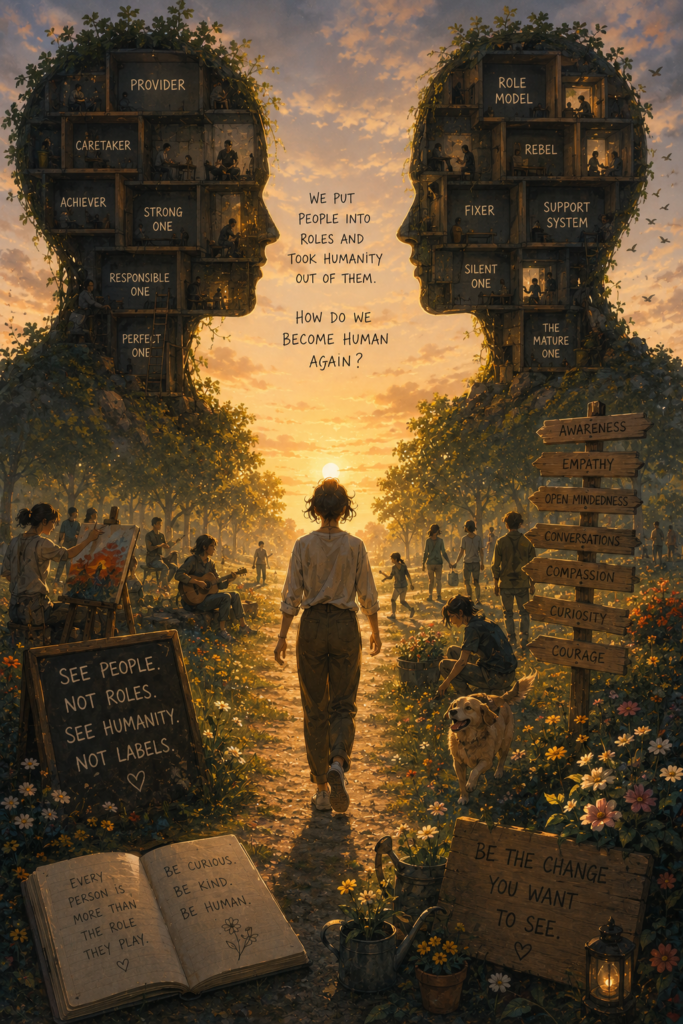
Once we understand that we have placed people into rigid roles and slowly stripped away their humanity in the process, what do we do after that realization?
How do we become human again?
How do we stop seeing people only as functions, labels, responsibilities, expectations, ideologies, or positions they occupy in our lives?
I do not fully know the answer yet.
But I do have a few thoughts I want to share.
It cannot be solved without self-awareness. Unless you personally have a problem with something, nothing really changes.
I think this is something I have learned through my own journey. It may sound obvious, but it really is not.
Until something starts hurting us, until the discomfort becomes unbearable, until the pain of staying the same feels worse than the effort of changing, most people do not genuinely seek transformation.
So unless our tolerance for that conditioning becomes lower, unless we begin to feel disturbed by it, it continues.
And then comes another question entirely:
How do we create that threshold collectively, at the level of society?
Because change can move from the individual to society, but society can also shape the individual.
That itself feels like an entirely separate essay.
But one thing I keep thinking about is this: awareness of others may be one of the biggest catalysts for change.
You may call it empathy.
Or exposure.
Or simply the realization that a different way of living is possible.
Among a group of ten people, even if just one person is open to new ideas, new ways of living, or new ways of thinking, there is potential for a massive cascading shift.
The reason could be anything.
Maybe they are rebellious. Maybe they are simply exhausted.
Maybe they are just unable to continue pretending.
But that willingness to be different begins the process.
Even if the other nine people do not want to change immediately, the idea still escapes into the world.
Their children may hear it.
Their families may absorb it.
Their social circles may slowly start reconsidering things they once accepted blindly.
What we often forget is that while the majority tends to follow existing structures, there have always been a few “nutcases” carrying the burden of change.
We usually thank them later.
Maybe it is some aunt in the family.
Maybe it is your father’s colleague.
Maybe it is someone quietly living differently within your own social circle.
Some become famous. Books are written about them. Newspapers celebrate them.
Others remain ordinary people with extraordinary conviction, moving through life with enough courage to make you question your own choices.
Sometimes we simply call them “lucky” when it feels too late for us to change ourselves.
Now this awareness, this realization that something is flawed in the system that we are following can come from many places:
The education system.
Stories from history.
Interviews with people living differently from you.
Social media—the reels, the sarcasm, the shared trauma that slowly reshapes perspectives.
Comedy and satire, which have always forced societies to confront their flaws.
Blogs like this.
Spirituality, empathy, soul-searching, the desire to become a better human being.
Friends and social circles—because the more differing viewpoints we encounter, the more open we become to new possibilities.
Now, some changes happen in a day.
Some take a decade.
Some may take generations.
But as human beings, we have to believe change is possible.
We are evolutionary creatures.
We survive because we adapt.
And over time, things that are kinder, more humane, and more beneficial for the larger collective tend to survive.
If human beings were only meant for cruelty, we would have destroyed ourselves long ago.
And despite how chaotic the world looks today, I still believe humanity, in many ways, is gentler than it once was.
For a beginning, though—
Be the change you want to see!
Leave a Reply