Category: R-Z

Essays starting with RSTUVWXYZ

  • The Lesson I Could Not Rush

    I don’t know why, but one feature in the human behavior manual seems to be this: we learn late.

    Not according to our timelines. Not according to our plans. We learn when we learn.

    And when we truly learn something, it stays.

    So why do we rush the process so much?

    What are we afraid of missing?

    Is it death? Age? Opportunity? Regret?

    Why is timing so important to us?

    I keep coming back to love.

    I think it is love that makes us rush.

    Love for a dream.

    Love for comfort.

    Love for security.

    Love for the people we care about.

    But perhaps fear plays an equal role.

    Maybe we are not only running toward something. Maybe we are also running away from something.

    Love creates the desire to reach a goal.

    Fear creates urgency.

    I can think of many examples.

    I want to build a home for my loved ones. I want them to feel secure. I want them to have comfort. I want to bring that comfort to their life as soon as possible.

    At the same time, I fear the instability that comes from not having a home of our own.

    So I chase.

    Partly because of love. Partly because of fear.

    And somewhere in that push and pull, life keeps trying to teach me faith.

    Perhaps that lesson is being thrust upon me.

    Or perhaps I am secretly looking for it.

    Either way, I have slowly realized that I want peace more than I want speed.

    Because the chasing was exhausting me. Running or chasing both are not sustainable after a point.

    While I was running from fear, I grew tired of running.

    While I was trying to create comfort for my family, I was sometimes creating tension around them.

    The dream was good.

    The urgency was not.

    And slowly I realized something uncomfortable:

    I had become the center of the very tension I was trying to eliminate. I was choosing comfort for them, over the negativity and pressure I was bringing to their life everyday.

    That realization forced me to change.

    Or at least begin changing.

    Maybe that is how lessons are learned.

    Not when life explains them.

    Not when someone wiser tells us.

    But when the consequences of not learning become impossible to ignore.

    For me, the discomfort I was bringing to the people I loved became unbearable.

    And that pain taught me what advice never could.

    It makes me wonder whether the pain we create for others is sometimes life pointing toward what we need to correct.

    And perhaps the pain we create for ourselves serves the same purpose.

    Maybe both are invitations.

    A lesson waiting to be noticed.

    Of course, not everyone learns from pain. Sometimes people simply collect more wounds, more resentments, more triggers.

    Learning is still a choice.

    But humans do learn.

    Slowly.

    Repeatedly.

    Often reluctantly.

    We often think understanding comes first and change follows. More often, suffering accumulates first, and understanding arrives later to explain what our heart already knows.

    Life keeps asking the same question in different forms until we finally answer it.

    And when the answer truly settles into your heart, something changes.

    The chase becomes quieter.

    The fear loses some of its power.

    The lesson stops feeling like information and starts feeling like wisdom.

    Lessons take time

    Perhaps that is why lessons take time.

    Not because life is withholding them from us.

    But because some truths can only be understood when we are finally ready to stop running long enough to hear them.

    Keep searching for your answers.

    Keep engraving your learnings into your heart.

    One day, the peace you spent years chasing may arrive quietly and decide to stay.

    And when it does, perhaps you will be able to help someone else find their way too.

    All in good time, my heart!

  • When Faith Feels Like Music

    Worshipping God should feel like having a favorite musician.

    Think about it.

    You have a favorite band. You love their music. There is that one song you play whenever you are feeling low, and somehow it makes you feel better. When they release a new song, you get excited. If they perform in your city, you attend the concert. You find other people who like the same music, and suddenly there is a community around something you love.

    You enjoy talking about the band. You enjoy discussing their songs. And when you see someone wearing their merchandise, you feel a strange excitement. This person likes something you like too.

    You like deep-diving into the lives of the band members, what they were going through when they wrote a particular song, what inspired a certain lyric, or what heartbreak gave birth to an album.

    Their stories inspire you, bring you comfort when you are down, and sometimes even make you shed a tear in silent support of struggles you never witnessed yourself.

    But here is the interesting thing about being a fan.

    You do not hate people who listen to different music. Typically.

    You do not think less of people who have never heard of your favorite band. You do not spend your day worrying about why they are not listening to the same songs as you.

    You simply think, “I like this music. This is my favorite band. Not everyone has to like it.”

    A song does not become less beautiful because someone else does not enjoy it.

    You wait for the next album. You continue listening to the music. Your relationship with the songs remains untouched.

    Even if nobody else in the world liked that band, you would still listen to it.

    You are perfectly capable of being the only fan in the room.

    That is how devotion should feel. Ideally.

    song of god

    You may talk about God. You may share what you love about Him. You may enjoy being around people who worship the same way you do. But your love for God should not depend on whether everyone else loves Him too.

    As long as you are allowed your space, and others are allowed theirs, love can exist peacefully.

    As a fan, you buy merchandise. You wear the T-shirt. You put up posters. You collect little things that remind you of the artist because they bring you joy.

    Perhaps prayer beads, temples, books, pictures, and rituals are meant to do something similar. They are reminders of someone you love.

    And there is another thing I find fascinating.

    When you listen to a song you love, it often feels as though the artist is speaking directly to you. Rationally, you know they wrote that song for millions of people. Yet somehow it feels personal.

    It feels like they understand something about you.

    Many people struggle with God because they think, “Why would God speak to me? I am not special.”

    But if you think of God the way you think about your favorite musician, something changes.

    The song was not written only for you, yet it still reaches you.

    The book was not written only for you, yet a sentence suddenly feels personal.

    The prayer was not spoken only for you, yet it comforts something inside you.

    Maybe devotion is not about being special.

    Maybe devotion is about feeling understood.

    And perhaps that is why people keep returning to God, just as they keep returning to their favorite songs.

    Not because they are forced to.

    But because every time they return, they feel a little less alone.

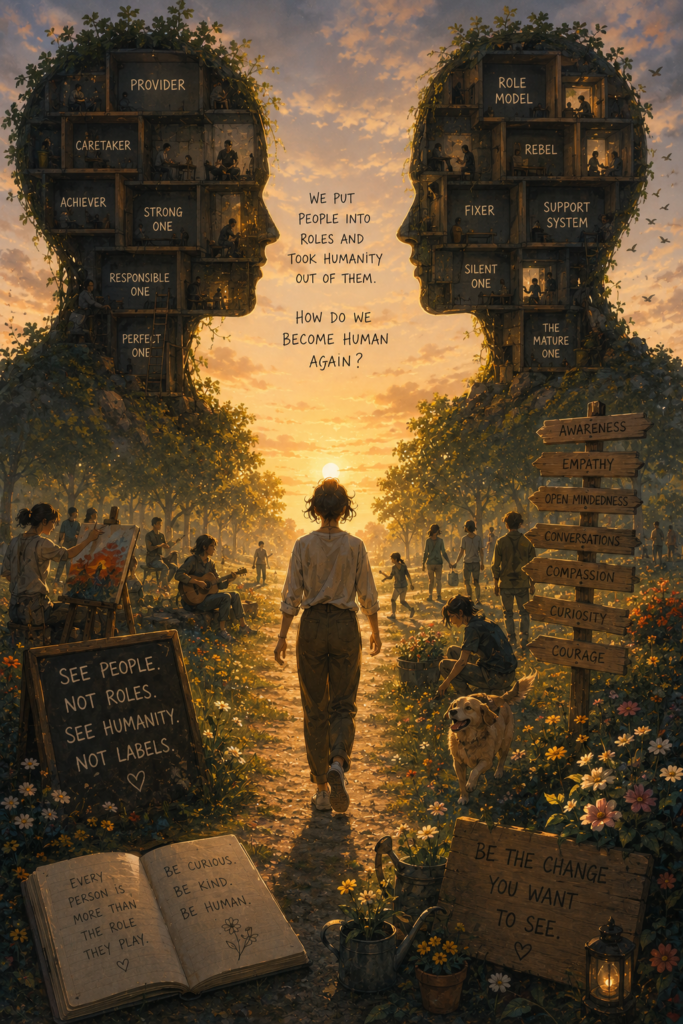
  • The Roles We Play — Follow-Up Thoughts

    To read the original essay, click here: https://thoughtsden.com/the-roles-we-play-the-people-we-forget/

    Someone asked me after the previous essay, “What next?”

    And I think that is the real question.

    Once we understand that we have placed people into rigid roles and slowly stripped away their humanity in the process, what do we do after that realization?

    How do we become human again?

    How do we stop seeing people only as functions, labels, responsibilities, expectations, ideologies, or positions they occupy in our lives?

    I do not fully know the answer yet.

    But I do have a few thoughts I want to share.

    It cannot be solved without self-awareness. Unless you personally have a problem with something, nothing really changes.

    I think this is something I have learned through my own journey. It may sound obvious, but it really is not.

    Until something starts hurting us, until the discomfort becomes unbearable, until the pain of staying the same feels worse than the effort of changing, most people do not genuinely seek transformation.

    So unless our tolerance for that conditioning becomes lower, unless we begin to feel disturbed by it, it continues.

    And then comes another question entirely:

    How do we create that threshold collectively, at the level of society?

    Because change can move from the individual to society, but society can also shape the individual.

    That itself feels like an entirely separate essay.

    But one thing I keep thinking about is this: awareness of others may be one of the biggest catalysts for change.

    You may call it empathy.
    Or exposure.
    Or simply the realization that a different way of living is possible.

    Among a group of ten people, even if just one person is open to new ideas, new ways of living, or new ways of thinking, there is potential for a massive cascading shift.

    The reason could be anything.
    Maybe they are rebellious. Maybe they are simply exhausted.
    Maybe they are just unable to continue pretending.

    But that willingness to be different begins the process.

    Even if the other nine people do not want to change immediately, the idea still escapes into the world.

    Their children may hear it.
    Their families may absorb it.
    Their social circles may slowly start reconsidering things they once accepted blindly.

    What we often forget is that while the majority tends to follow existing structures, there have always been a few “nutcases” carrying the burden of change.

    We usually thank them later.

    Maybe it is some aunt in the family.
    Maybe it is your father’s colleague.
    Maybe it is someone quietly living differently within your own social circle.

    Some become famous. Books are written about them. Newspapers celebrate them.

    Others remain ordinary people with extraordinary conviction, moving through life with enough courage to make you question your own choices.

    Sometimes we simply call them “lucky” when it feels too late for us to change ourselves.

    Roles we play

    Now this awareness, this realization that something is flawed in the system that we are following can come from many places:

    The education system.
    Stories from history.
    Interviews with people living differently from you.
    Social media—the reels, the sarcasm, the shared trauma that slowly reshapes perspectives.
    Comedy and satire, which have always forced societies to confront their flaws.
    Blogs like this.
    Spirituality, empathy, soul-searching, the desire to become a better human being.
    Friends and social circles—because the more differing viewpoints we encounter, the more open we become to new possibilities.

    Now, some changes happen in a day.
    Some take a decade.
    Some may take generations.

    But as human beings, we have to believe change is possible.

    We are evolutionary creatures.
    We survive because we adapt.

    And over time, things that are kinder, more humane, and more beneficial for the larger collective tend to survive.

    If human beings were only meant for cruelty, we would have destroyed ourselves long ago.

    And despite how chaotic the world looks today, I still believe humanity, in many ways, is gentler than it once was.

    For a beginning, though—

    Be the change you want to see!

  • The Discomfort of Having a Friend

    I worry about having a friend.

    The discomfort of depending on them.
    The discomfort of relying on their presence to complete conversations you do not want to have alone.

    I can wait for years just to complete that conversation.

    The conversation waits within me.
    The grief holds itself carefully inside me.
    The pain stays safely stored in my heart, waiting for its release.

    Is my friend the place where I seek redemption?

    It started as nothing, and somehow became everything.

    In a world obsessed with defining love through the physical, this platonic crush became my holy grail for peace and fun.

    The urge to talk to them in the group while still remaining courteous.
    You cannot reveal that every conversation quietly seeks their emotional validation.

    The subchat.
    The side group.
    The secret extra details.
    The expressions you need to share with them before the day can end peacefully.

    I stay with the comma until I talk to them, and they become the period of peace.

    They turn the page for me.

    I did not know that my urge to add subtitles to every conversation was the kind of love I needed during this mundane life.

    Subtitles only they would understand.
    Subtitles you cannot say out loud, because others would notice.

    Love holds very little power when it comes to overly territorial friendships.

    You cannot cross that line.
    You cannot come between that bond.

    The closeness becomes territorial.
    Almost sacred.

    Where love sometimes comes with fragility, disturbed as easily as sand touched by waves, friendship feels carved in stone.

    Not a handmade carving, but something shaped slowly through time.

    Not just what waves do to underground rocks, but what a rope does to a stone wall after years of friction.

    Friendship endured what hurt the most.

    It saw your friend withering in pain, and still you stayed.

    It tests your stamina.
    Your appetite for love.
    Your ability to remain.

    Discomfort of a friend

    But sometimes, you have to cut this cord yourself.

    Untie this seemingly unbreakable knot with your own hands.

    To break a friendship, you have to break the stone.
    The very stone you carved your promises into.

    And while smashing it against the ground would be easier, you still want to be delicate about it.

    So instead, you break it on your own feet.

    While your friend cries, you bleed.

    But you still do it.

    Because staying hurts more.

    Yes, you will make new friends.

    But the piece of heart they took with them stays there forever.

    And eventually, you stop hoping to get it back too, because you would not know what to do with that piece even if it returned.

    Some memories are not erased.

    Only buried.

  • The Person I Post

    The way we exist on social media is different from real life, or so I believe.

    Social media is not just an extension of our social personality. It is also an extension of our internal world.

    It has quietly become a part of our resume, our biodata, our social life.

    Without meeting you, I can already assess you, put you in a box, admire you, judge you, or completely character assassinate you based on your profile.

    I can see who you are friends with, who you follow, who you admire.

    Based on your shares and posts, I can guess your political inclinations, your ideals, your idols, your value system.

    I can also see whether you are a loner or socially desired.

    Whether your life looks curated or chaotic.

    Whether your taste feels refined or whether we may never align at all.

    The strange part is this:

    Without ever truly knowing a person, we can build an entire story about them.

    And that makes me wonder –

    Is social media really the right place to start knowing someone?

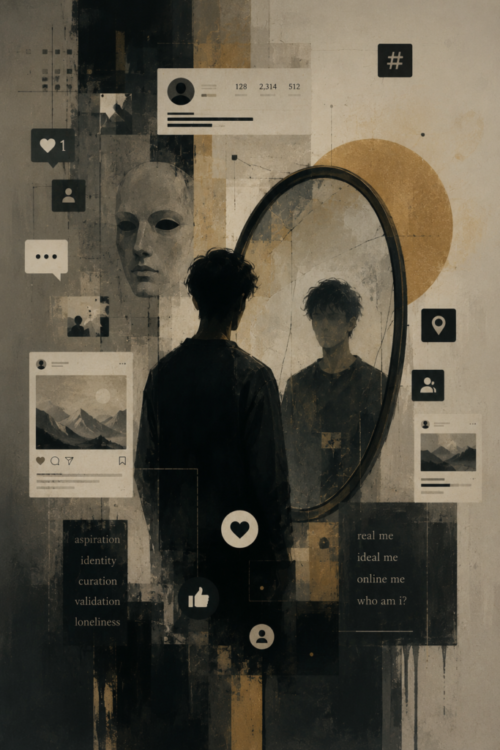
    Is it an extension of personality, a mirror, or an aspiration?

    Is it who people are?

    Or who they wish they were?

    Are we presenting ourselves the way makeup presents a face – enhanced, edited, softened, strategically lit?

    Or are we quietly catfishing each other emotionally through aesthetics, captions, and carefully selected vulnerability?

    I remember a time when social media felt like everything.

    If something was not posted, it almost felt like it never happened.

    It was about how you arrived.

    How your life looked.

    Your online presence sometimes mattered more than your real one.

    Social media and me

    And now I wonder –

    Is social media slowly making me live a delusional life?

    Is it making me more aspirational, or more disconnected from reality?

    More authentic, or more performative?

    More expressive, or more aware of being watched?

    Can social media ever give me the courage to fully endorse the actual weird version of myself?

    And harder still:

    Do I have the courage to admit that a part of me genuinely wants to live like the person I present online?

  • You Become What You Fight

    There are people who make something inside you tighten. Your jaw, your chest, your thoughts, your whole being for an instant!

    People who don’t just irritate you, but make you want to correct them, fix them, defeat them, hold a mirror up to their face, make a movie on their behavior and show it to them in an iMax theatre to tell them how it feels.

    We like to believe they are the problem. And sometimes they really are!

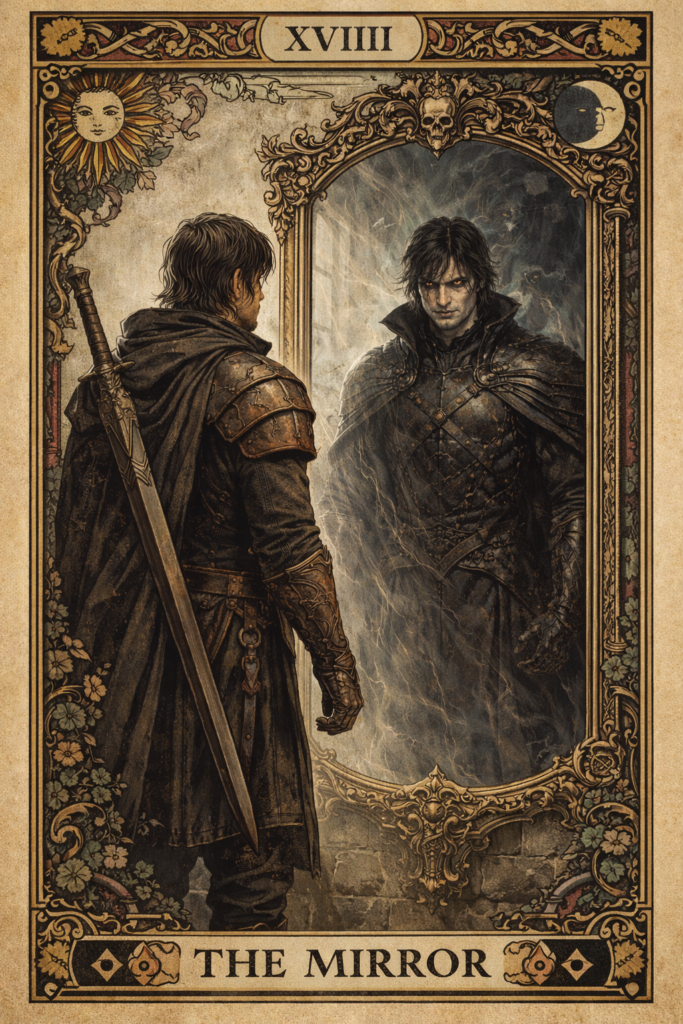
    But what if they are also the mirror, mirror of our inner world?

    Carl Jung spoke about the “hero’s path”. It’s the conscious choice to remain good, to resist becoming what one hates. A quiet resistance against internal and external corruption.

    Yes, you are the hero (or heroine).

    And these people, you may call them enemies, are creatures that make you clench your teeth. You wish to change them, or send them to Mars, with no between!

    But they serve a bigger purpose.

    We can’t appreciate light without dark, good without bad, and in the same way, we can’t fully know ourselves without the people we despise.

    They remind us what we do not want to be.

    Joseph Campbell, influenced by Jung, said every hero must confront their “Shadow”. They are the darker, suppressed parts of ourselves. The real victory is not destroying them, but integrating it without being consumed.

    Because sometimes, anger rises fast. It asks you to stoop, to match, to return the same energy.

    But pause – even for a moment – and you’ll see:

    Competing with them makes you more like them, and less like you.

    The reason you hate your enemies is because they have hurt you. And when you try to hurt them in the same way, you become the very thing you despise.

    This is not a sermon. This is just honesty.

    I don’t want to be like my enemy.

    I don’t want to carry the same traits as the person I dislike.

    I want to remain different.

    My enemy tests my moral meter. My belief system. My boundaries.

    The people I dislike show me how firm, or fragile, I really am.

    The values I despise do something strange: they reassure me when I am drifting.

    They force me to check myself.

    If you’ve seen Star Wars, George Lucas built its core on this. The constant pull between becoming the evil you fight, or choosing something higher.

    We’ll talk about forgiveness and acceptance another time.

    You become who you fight

    For now, sit with this:

    Our anger is a psychological mirror.

    At the core of the hero’s path is a difficult realization: 

    We are not just fighting them, we are resisting the part of us that could become them.

    It sounds dramatic.

    But even small unkind choices slowly build the courage to become someone harsher than we intended.

    To become as mean as my enemy.

    To be unkind to those who have meant no harm.

    To be selfish when others are giving freely, without asking.

    To hurt those already broken into a thousand pieces, just to mend my own wounded pride.

    To stand and watch while someone’s world burns, because I had no water to save my own.

    To turn as cold as Antarctica, because warmth would make me vulnerable.

    I am scared to become all of this, just to put my enemy down.

    So yes, I want to thank the people who frustrate me.

    They have made me think harder. They have forced me to question my beliefs. They have given me ground to stand on.

    Even disagreement has shaped my voice.

    There are many versions of truth, many value systems. But being challenged has made me look deeper, why I believe what I believe, and where I still need to grow.

    It has also shown me how small my thinking once was.

    I don’t want a world where everyone is like me. It’s not possible, and maybe not even desirable.

    So the only way I can exist meaningfully in this world is by choosing, again and again, not to become what I cannot respect.

    Not out of superiority. But out of awareness.

    And in the end, as Friedrich Nietzsche warned:

    “Beware that, when fighting monsters, you yourself do not become a monster. For when you gaze long into the abyss, the abyss gazes also into you.”

  • The Piano We Never Touched

    Most people don’t refuse new things because they are certain they won’t enjoy them. They refuse because trying requires a brief surrender of certainty, of control, of the version of themselves that already knows how to exist. 

    New experiences don’t just offer pleasure; they threaten familiarity. And familiarity, even when it’s limiting, often feels safer than the unknown.

    The more you hide, the more joy hides!

    What people often don’t understand when they refuse to try new things, or ridicule others for trying them, is that they are not rejecting an activity. They are rejecting a feeling. An experience. A possible doorway to joy.

    If someone has already tried something and genuinely disliked it, that’s different. But to decide in advance that nothing new can bring happiness and joy, that everything meaningful lies strictly within one’s comfort zone; that is not wisdom. 

    It is a quiet waste of life.

    How can you know you don’t like something unless you’ve felt it?

    Why experimenting is the key to knowing more

    I’m not talking about drugs or anything risky or harmful to health or society. I mean very basic things. Simple things. New food. A new sport. A different kind of book. A place you never imagined yourself in. Sometimes even a version of yourself you never thought you could be.

    Imagine if the only instrument you had ever known was a pair of tongs, and you believed that was all music could be. You made do. You accepted it. And then one day, you discovered a piano. You wouldn’t just hear new sounds, you would realise how limited your definition of music had been all along.

    This is true of food. Of art. Of movement. Of relationships. Of joy itself.

    Unless you have experienced something, how do you know what it might awaken in you? You might discover a part of yourself, a joy bone, you never knew existed.

    Trying new things

    It may not completely be your fault

    Sometimes, this resistance to trying new things is not arrogance. It is fear. For people struggling with mental health issues, change can feel unsafe. Predictability becomes survival. Newness threatens the fragile sense of control they have built. Avoidance, in such cases, is not a failure of character. It is a nervous system doing its best to cope.

    But there is another kind of resistance. One that comes not from active pain, but from old, unexamined trauma, now fossilized in the form of projection.

    What is not processed stays like a bone in your body

    This trauma is so old and so familiar that it no longer feels like trauma at all. It has calcified. It has turned into a habit, into fixations and rigidity. Into a personality that prides itself on being “practical” or “settled” or “realistic,” when in fact it has simply stopped being curious.

    That’s where the real question lies.

    Are you losing your curiosity?

    When someone does something you haven’t – do you feel intrigued, or irritated?

    Are you genuinely uninterested, or quietly grieving a life you never explored?

    Judgment, more often than we admit, is grief wearing moral clothing. Labels give us a sense of superiority, but they also protect us from looking at what we might be missing.

    Awareness ,of both the life you have lived and the life you haven’t, is what slowly brings curiosity back. And curiosity, when paired with safety, leads to joy. Not all at once. Not dramatically. But steadily.

    An orange waiting to be peeled

    As long as you keep peeling away the layers you’ve built around the possibility of joy, you will keep finding it, sometimes in places you never thought to look.

    After all, the unlived parts of life don’t disappear, they remain veiled. 

    They wait.

    Carpe diem, hooman!

  • The Violence of Casual Words

    I saw my childhood friend standing on the other side of the road. We were meeting after almost two years.

    We both started walking towards each other hurriedly. We wanted to hug already. We had missed each other so much.

    The moment she saw me, she said,

    “Hey, you’ve become rounder!”

    My heart sank.

    I couldn’t say anything. I laughed, even though there was no joke to laugh at.

    If you pause for a moment, this probably reminds you of something familiar. Of how normal it is for us to comment on people’s bodies. How casually we highlight things that someone lives with every single day. We have played both these roles, many times in our lives.

    Acne. Pigmentation. Weight gain or loss. Greying hair. Balding head. Wrinkles. 

    The list goes on.

    What’s common about this list is that most of these things are not fully within someone’s control. They can’t be fixed overnight. They are constantly noticed, constantly judged, sometimes even by strangers. And you can almost always tell these are the very things someone already feels conscious about.

    Society makes sure you know when you don’t meet its standards. And sometimes, it does the opposite, it praises you excessively when you do. You can feel insecure for not fitting in, and strangely, insecure even when you fit in too well. As if having good skin, or the “right” body, itself becomes something to be evaluated. You are always under prying eyes.

    The point is not whether a feature is considered good or bad. The point is this: if something is already costing someone their peace of mind, then as a thoughtful human being, it’s important to stop commenting on it, as your sole right and responsibility to.

    A big no to unsolicited advice.

    A bigger no to pointing it out in public spaces.

    And an even bigger no if it’s the first thing you say to someone you haven’t met in a long time.

    Even if you believe you have an expert solution, pause. 

    Ask yourself – did they ask you? And if you genuinely want to help, ask for permission first. Make sure you are offering care, not discomfort.

    Don’t tell them how easy it is unless you can fix it in a minute.

    Don’t tell them to ignore it, because they already can’t.

    And if you feel an urge to share your opinion anyway, take it to the restroom. Say it to yourself in the mirror. Just because you have the ability to express doesn’t mean others owe you the emotional labour of listening to it.

    Now comes the more responsible and empathetic part.

    Without feeling loved despite their perceived flaws, people never feel safe enough to do something for themselves. 

    Safety is what allows growth, not shame. If the growth is made under pressure, then it leads to dissociation from your true self.

    You are not living then for yourself, you are performing for others. 

    And performers need a break too. You are you, not a performer, born to just get praises from others.

    Violence of words

    The most meaningful thing we can offer another human being is the assurance that they are worthy of happiness as they are.

    When people feel safe, something softens inside them. Not because they were corrected or reminded, but because they were met without judgment. 

    Safety doesn’t make people careless, it does the opposite. It gives them the space to listen to themselves, to notice what they need, and to care in ways that are self-directed rather than defensive. 

    Personal change grows best in environments where dignity is protected. And when care is offered without commentary, people don’t shut down, they show up. For themselves, and eventually, for the world around them.

    Something to remember:

    Most people are not failing at life, they are figuring it out in real time. They are carrying things they haven’t learned how to name yet, making choices with the tools they have today, not the ones they wish they had. 

    In such moments, kindness is not indulgence; it is orientation. 

    When we offer support instead of scrutiny, we give people the steadiness they need to find their own footing. And perhaps that is all care really asks of us, to walk alongside others while they learn, without rushing them, correcting them, or turning their becoming into a performance.

    After all the famous Buddhist monk, Thich Nhat Hanh, said once,

    “Compassion is a verb.”

  • The Handkerchief in the Pocket

    If you love someone and you don’t feel an urgency to take care of them, not dramatically, not performatively, but instinctively; then something is missing. 

    Either you are not truly in love, or you have already taken them for granted. Because love, at least in its living form, does not feel leisurely. It doesn’t say we’ll see. It doesn’t wait to be convenient. 

    Love carries a certain urgency, a quiet but persistent one, where you want to run, stretch yourself, bring the sky to the earth if that’s what it takes.

    The moment love turns into ‘meh’, something subtle has shifted. Not necessarily hatred or anger , just certainty. The certainty that this person is not going anywhere. And once that certainty settles in, the rush disappears. What’s the hurry anyway? They’ll manage. They always do. 

    And without realising it, love starts outsourcing care to time, habit, or the other person’s resilience.

    For me, love means having a very low threshold for the pain of the person you love. Their discomfort should not register as minor to you, even if it is objectively small. You should feel unsettled by it, moved by it, pulled towards it. Not because of guilt. Not because of duty. But because love rewires you that way. 

    Their pain enters your nervous system faster than logic does.

    You want to support them. You want to ease it. You want them okay, not later, not eventually, but now. That impulse doesn’t come from obligation. It comes from attachment, from care that hasn’t gone numb yet.

    And maybe that’s the real marker. Love isn’t grand gestures or lifelong promises. It’s the inability to stay indifferent. The discomfort you feel when the person you love is even slightly hurting , and the instinct to move towards them before the world teaches you that you don’t have to.

    Adding some of my thoughts through this poem written by me;

    अगर मेरे होने पर भी तुम्हें खुद को मुताबिक़ करना पड़े,

    तो वो इश्क़ ही क्या जिसमें तुम्हें शिकायत करना पड़े।

    यूँ तो मुझमें और तुममें बस एक ही फ़र्क है,

    तुमने आँसुओं को अपनी मोहब्बत का हमसफ़र माना,

    पर मैंने हँसी के सिवा तुम्हारे चेहरे पर

    कोई और तसव्वुर ही न जाना।

    लफ़्ज़ों के जाल, वादों के महल,

    ये सब मैंने कभी सीखे नहीं,

    झूठे ख्वाब किसी को

    जान-बूझकर कभी दिखाए नहीं।

    बात अगर रूठने तक ही आ रुके,

    तो जेब में रखा रुमाल

    महज़ नुमाइश के लिए नहीं।

    Handkerchief
  • The House the Brain Becomes

    Language is more important than we think.

    If we cannot speak, express, or label something, we cannot build the quintessential community every human being needs. And I don’t just mean the outer world communities like friendships, families, societies , but an inner world too.

    The inner world community is the harmony between the nervous system and all the other organ systems. It is the one that quietly decides our overall wellbeing. The one that decides what feels safe, what feels threatening, and what feels impossible to touch.

    When something inside us has no language, it exists in isolation.And isolation, even internally, is unbearable, and unhealthy.

    How it starts

    This usually starts during childhood. If we don’t teach children how to name what they are feeling, the feeling doesn’t disappear. As children, the world is new, and so are the emotions that come with it. Understanding them, naming them, and allowing them to be felt is a crucial part of growing up. It becomes a skill that carries through life.

    If humans don’t learn how to name their emotions, it can feel like being put inside a box they cannot come out of. 

    A box full of emotions

    Emotions are overwhelming by nature; they flood the body before the mind can make sense of them. And when there is no language to hold that flood, the only strategy left, especially for children, is to push it down. Acting out emotions is often inconvenient for the adults around such children, which makes the child feel unsafe expressing them. So they suppress it. 

    Not because suppression is healthy, but because it brings temporary safety and apparent relief.

    Over time, the nervous system learns this: don’t try to understand- just shove it away.

    Why shoving it down seems like nothing is wrong when actually everything is

    Shoving down often looks harmless. It looks like a distraction. Watching TV. Reading books. Staying busy. Overplaying. Oversleeping. Avoiding stillness. Avoiding people. Avoiding themselves. Talking too much or talking too little. We tell ourselves it’s alright, that it doesn’t mean anything, that it’s just passing time.

    But shoving down is actually like filling your brain with waste polythene bags.

    Each one feels insignificant. Each one polybag (emotion) light enough to ignore. So you keep adding them, telling yourself it’s fine, it’s nothing, you’ll deal with it later.

    The weight of keeping – the interior design of your brain

    One day, you open the bag and realise it’s no longer many small things. It’s one large, tangled mass of useless and not-so-useless things. Some of it you may have needed once. Some of it mattered at one point. But all of it has already done its work. 

    It has left its imprint on your nervous system – on how your body reacts, how quickly you get overwhelmed, how unsafe certain emotions feel without you even knowing why.

    If your brain were a house, you would eventually stand there wondering why you placed so many bags in one corner. They’ve taken up the space of everything else. The sofa. The almirah. The space to sit, rest, and live.

    The dilemma becomes absurd – should I remove the useful things from my house just to make room for this waste?

    The tragedy is not just that these bags are useless. It’s that they are toxic too.

    Even if each one is light individually, imagine how old they are. Polythene bags from vegetables. Milk packets. Clothes covers. Years old. Decades old. Rotting quietly.

    Just like emotions – decades old.

    When you finally start scrummaging through them, you are shocked by what you have kept, and why. And strangely, you don’t know what to do with it anymore. You don’t know where it belongs. You don’t know how to sort it. You don’t know why it’s still here.

    But the truth is simpler than we make it. Throw it. It is not your responsibility to preserve waste.

    Language

    They are not just bags but your emotions!

    Except emotions are not disgusting and toxic. They are meant to be met. They are how the body communicates safety, danger, joy, and connection. 

    Emotions are a language – one we must learn to understand.

    Learn to speak the language of emotions

    This is where outer language comes in. Language is the bin. Language is the door through which things can exit. When you can label an emotion, when you can put a word to it, its job is done. It no longer needs to live in the body or haunt the nervous system. It can move on.

    But when there is no word, no name, no language, you are simply shoving another polythene bag into the next room of your brain. And that one, over time, becomes even more toxic.

    Perhaps language is not meant to explain us, but to release us.

    What remains unnamed does not disappear , it waits, settles, and slowly becomes structure, shaping how we relate, react, and retreat.

    In that sense, language is not expression but movement, a way for inner life to remain fluid instead of fossilised.

    And maybe freedom is nothing dramatic at all, but simply the ability to let experience pass through us without having to become it.