Tag: relationships

  • Mirror and Tango

    Marriage is a maze.

    No matter how much you prepare for it, you still find yourself standing in situations that make you wonder whether you prepared at all.

    The first decade of marriage is particularly interesting. Most couples face some of their toughest storms during the first five years. Many go on to build healthy marriages, but those early years can be surprisingly difficult to navigate.

    Becoming a parent during this period is like facing a tsunami in itself.
    But marriage, with or without children, is already enough of an event.
    It is not just a meeting with another person. It is an intervention with yourself.

    The most amusing characters in this entire story, according to me, are the parents/elders of the couple.
    Typically, anything good about their grown up child is attributed to the family. Any uncomfortable change, however, is attributed to the child’s partner.

    It is exactly how things worked during childhood.
    Anything kind, intelligent, or impressive the child did was credited to the family. Anything rude, rebellious, or unkind was blamed on a new friend.

    It is as if the child has no nature of their own. And to some extent, that is true.

    Children borrow heavily from the world around them. They imitate behavior before they develop a personal understanding of it.They are still forming their perception of the world.They observe, absorb, and experiment.

    A friend, a movie, a teacher, a sibling, or even a brief interaction can influence how they behave, be it temporarily.

    But while behaviors can be copied, feelings usually aren’t.

    What children often imitate/notice is the attention surrounding a behavior. They notice what gets rewarded, what gets punished, what gets a reaction, and they learn from that.

    But marriage is where this explanation starts becoming less convincing.

    There is a general perception that adults become someone else because of the company they keep. After marriage, parents may think their child’s spouse changed them.

    Partners often tell each other:
    “You bring out the worst in me. I haven’t seen myself behaving like this before.”
    I have a slightly different understanding of it.

    I think marriage brings out what was always there. It just never had a vent.

    From the kind of partners we choose to the ways we push our loved ones away, the things that shock other people were often present long before marriage. Nobody created them.

    Marriage simply lowers the energy available to maintain a facade.

    The demons were always there. Now they are sitting on the porch, giggling!

    What I’m trying to say is that marriage is rarely something entirely new behavior wise on an individual level. Especially in its early years, it is a reflection of who we already are and the childhood and the family history we carry with us.

    Marriage brings our vulnerable self to the surface. And to protect that vulnerable self, we do all kinds of strange things.

    We become controlling, avoidant, defensive or critical.

    The healthier we are emotionally, the healthier those reactions tend to be. The more wounded we are, the more dramatic they become.

    So if you think your partner is being irrational, strange, or difficult, spend some time observing their relationship with their primary caregivers.
    You will find a lot of answers there.

    If they were never allowed to express their feelings as a child, they may now express them with overwhelming intensity, because this relationship finally feels safe enough to do so, or they want to define that boundary somehow.

    Sometimes what appears as anger is fear looking for protection. They are frightened on the inside, so they become louder on the outside.

    Some people even thrive on chaos and drama because chaos feels familiar. Peace feels foreign. Predictability feels suspicious. The nervous system often mistakes familiarity for safety.

    If childhood taught them to shrink themselves around money, resources, or opportunities, they may carry that scarcity mindset into marriage and unintentionally pull their partner into it too.

    Sometimes the opposite happens.

    The more restricted they were growing up, the more expansive they became as adults.
    The more silenced they were, the louder they became.
    The more controlled they were, the more fiercely they protected their freedom.

    The point is not to excuse unhealthy behavior. The point is to understand where it came from.

    When you learn to trace a reaction back to the life that shaped it, many things begin to make sense.

    That is why I think one of the most valuable things you can do in the first decade of marriage is to understand your partner’s life before you enter it.

    Not because the past determines the future. But because it reveals the patterns that are most likely to show up in it.

    Marriage

    The longer I observe marriage, the less I see it as a union of two people and the more I see it as a meeting between two histories.

    Two childhoods.
    Two nervous systems.
    Two sets of fears, hopes, wounds, and coping mechanisms.
    The relationship simply becomes the place where they finally meet.

    Marriage is the mirror.

    Some people spend years trying to fix the reflection standing across from them. Others become curious about why that reflection exists in the first place.

    Then the real questions begin.
    Do you feel equipped to hold the wounds that still exist?
    Do you have the patience to keep offering a mirror?
    Are they willing to look into it?

    All these questions can help you decide whether your partner can match the level of awareness you are at.
    Because the most important question of all:
    Are you willing to do the same with your own patterns?
    Because marriage is not just a mirror for your partner.
    It is a mirror for you too.
    And sometimes the hardest reflection to face is your own.

    If both of you are interested in finding and figuring out your own patterns, the chances are you will grow together but if only one of you is taking the burden of growing with changing times then it will look like driving a car with one tire bigger than the others, a marriage that is wobbly.

    This is not a guide on how marriages work, but a nudge on it is more than what looks on the surface. It requires work.

    The real work starts when we are ready and it may require professional help. Whether you do it for this marriage or the relationship that comes later (divorce or another romantic relationship or parenting), that’s a personal choice. But it will always help to learn how much of your behaviour is intentional and how much of it is a response to something at which you had no control.

    In the end, marriage is a lot like a tango. It takes two people to create the dance, but each dancer is responsible for learning their own steps. We are not burdens waiting to be dragged across the floor. We are individuals learning our own rhythm, hoping to find someone willing to learn theirs too.

    And when both people are willing to do that, the dance becomes beautiful.

  • One Life. Many Truths.

    Humans are rarely one thing at a time.

    We love people we resent. We stay loyal to things that exhaust us. We believe in honesty while still lying to protect ourselves.

    We are systems built to hold contradictions, contrary to popular moral belief.

    You may love your parents, yet you can still be angry at them for something till death. You are annoyed by your best friend, yet you show up every single time they are in trouble while muttering, “Here we go again.”

    We know a particular political leader or party is a nuisance, yet we still go and vote for them. We hate not being able to express our true anger, yet when that creepy boss walks in, we put a smile on our face because that is what diplomacy teaches us.

    We are tired of explaining to our spouses or partners how irresponsible they are, yet we are ready to clean up after their mess every time, both physically and metaphorically.

    We constantly hear our parents complain about their siblings, and eventually we begin disliking our uncles and aunts too, to the extent that we do not even want to see them anymore. Yet when we ask our parents to stop entertaining them, we are the ones scolded for being hard-hearted.

    All these examples reveal a strange dichotomy in human behavior, one that even we fail to understand within ourselves. When others do it, we are quick to call them hypocrites. We believe one feeling cannot exist if another feeling is stronger.

    We pressure people, especially those close to us, to choose one difficult truth over another. Yet we ourselves continue to exhibit contradictory emotions of love and hate without even recognizing it.

    This leads to an interesting truth about the nervous system: human beings find peace not in perfection, but in their ability to hold two conflicting feelings at once.

    Yet humanity is constantly taught in absolutes. Absolute morality. Absolute goodness. Absolute honesty. Absolute loyalty. We are told the ideal human is clear, certain, and unwavering. But if you observe the human mind closely, it begins to crumble under the pressure of perfection.

    The brain is full of conflicting thoughts, mistakes, impulses, imperfections, and moral dilemmas. The more we fight this truth, the more difficult it becomes for us to grow.

    We place chains upon our moral flexibility. Instead of arriving at our own understanding through mistakes, experience, and reflection, we demand that people display only one acceptable behavior and belong to only one school of thought. This creates pain inside us.

    The pressure to choose one truth slowly damages our ability to make better choices. It creates distance in relationships. It pushes us toward only those people who validate every contradiction inside us. And when that validation is absent, it can freeze us emotionally or push us toward addictions, numbness, escapism, or paralysis. Sometimes, it may even create an artist.

    one life many truth

    The behaviors and emotions within humans can be contradictory, but the values imposed upon them are often rigid and singular. We are told we cannot hold conflicting beliefs, even though the human brain naturally does. That is probably the biggest coping mechanism that the human brain has.

    And this contradiction reveals something deeper to me. This conflict of wanting to be a certain way but behaving in a different way reveals something about our inner world.

    I believe the values we cling to the hardest are often born from the places where we were hurt the most. The thing you judge others for most intensely is often the thing that frightens you the most internally. A kind of projection.

    If someone is deeply against theft, perhaps something precious was once stolen from them, emotionally or physically, and they never recovered from it.

    If someone aggressively pushes a healthy lifestyle, maybe they have witnessed an illness destroy someone they love. Maybe they are scared of being dependent on someone one day and rejected while going through a difficult illness. They are scared of being vulnerable. Maybe they took care of someone close and got so deeply hurt in the process that now they don’t want to inflict the same pain of caretaking on their loved ones.

    If someone insists on stable jobs over artistic careers, perhaps they once watched a person struggle financially, or perhaps they themselves were denied the freedom to pursue what they truly wanted.

    Sometimes the values we defend most passionately are not just principles, they are protective walls around old wounds.

    And I experience it is important to give ourselves and others the freedom to discover our truths without shaming contradiction or emotional complexity. Conversation helps us understand that many people behave the way they do to protect themselves, avoid fears they are not ready to face, or survive truths they do not yet have the courage to confront.

    Grace could guide this journey in a gentler way.

    Humans exhaust themselves trying to become morally pure. Is it worth it? Perhaps. But can the journey be gentler? Absolutely.

    We often mistake healing for certainty, as if maturity means becoming unwavering and untouched by contradiction.

    But maturity is not the absence of conflicting feelings. It is the ability to hold them without tearing yourself apart , I believe.

    To love and still feel anger.
    To leave and still miss someone.
    To forgive and still remember.
    To fear becoming your parents while slowly understanding them too.

    The mistake we make with humans is demanding certainty from people who are still trying to understand themselves.

    Contradiction is not always confusion. Sometimes it is evidence of an internal negotiation between fear, morality, survival, desire, love, and experience. Sometimes it is growth in motion.

    Healing is not about becoming emotionally absolute, but about questioning your inherited beliefs, your rigidity, your projections, and your fears until you slowly arrive at a truth that genuinely feels your own.

    Not borrowed.
    Not imposed.
    Not fear-driven.

    But understood through living.

  • Building a better past- One memory at a time

    Memory has always been my nemesis.

    My perception of my childhood memory is like living in a house surrounded by monkeys. The moment you start to think something good about that house, you remember one dangerous encounter with that big red-faced monkey! Suddenly you are 6 again, being chased, alone and scared.

    You don’t want to go back to that house again.

    I envy those with good childhood memories. I hear these lucky people reminisce about the good old days, about how they would always want to relive their childhood. I sit there tasting the bitterness of relationships, the swelling of my cheek my childhood brings me.
    I wonder how they hate today. I wonder how they are not scared of being tiny again, when someone else decides how your day went.

    How are they not worried about whether they will be served a slap or food for dinner. Also, whether they miss the game night at their friend’s place, or only remember the weird brother who tried to touch you inappropriately when nobody was watching.

    Nobody would believe that story, especially because I haven’t told anyone. I don’t want to be held responsible for my 6-year-old self now, you see. I am not sure if I somehow invited it with my flat child body wearing shorts and a T-shirt.

    I was ugly according to my family.

    We don’t talk about that memory ever, yet it pops up every time I see a child playing with an adult. It must be my brain’s fault, tainting anything good it sees.

    I listen to those with beautiful memories with wondrous eyes, just like a child thinks about unicorns. Yet it is very rare for me to encounter those who want to forget as much as I want to. We still remember everything too vividly. It doesn’t seem like something that happened a long time ago.

    The people in my memory may not exist anymore, maybe not even on this Earth or just not in my life anymore, but I have to live with those faces till death. I remember their eye color and even their gait, yet I am uninterested in learning new faces now.

    What if I would have to strive to forget them too?

    The burden of memory, especially the bad ones, is immense. You are combing your hair and bam! You remember how your grandmother oiled your hair when you were young. There is a smile erupting at the thought of those fingers on your scalp. And then suddenly this memory becomes a ghost, and you remember how your hair was pulled when you made the tiny mistake of rubbing shoe polish on the floor. Maybe the oil strengthened the hair and the spirit too.

    Today I don’t let anyone control what I paint with my shoe polish.

    Eventually, I started taking matters into my own hands. I made my money and made new good memories the first chance I got.

    Better past

    The moment I learnt I am not automatically blessed with good ones, neither memories nor people, I decided to find new people for my new and better past.

    I was born cursed, but I can bless myself too.

    When I embarked on my journey of owning my life, I was made to feel ashamed for those attempts. But I have tried to live because I have stopped trusting anyone else, especially time. I’m scared of giving that control to anyone now.

    I find my people and my resources. My time has to keep up with me. I will not let them disappoint me again.

    I only want to indulge in good and meaningful moments, making memories with only those who are worthy of it. I want to invest in memories for my old age.

    I want, in my final moments, when the movie of my life plays in my head, no matter how painful the start is, for my final memories to be full of love and warmth.

    I may be the weak child, but I shall not remain so.

  • The Roles We Play — Follow-Up Thoughts

    To read the original essay, click here: https://thoughtsden.com/the-roles-we-play-the-people-we-forget/

    Someone asked me after the previous essay, “What next?”

    And I think that is the real question.

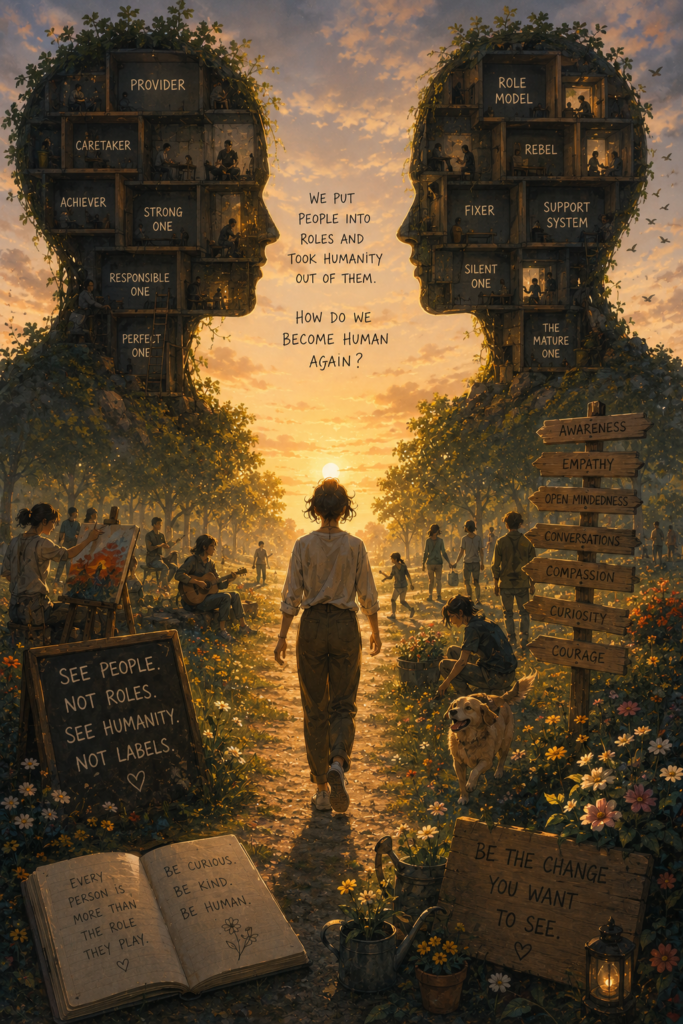
    Once we understand that we have placed people into rigid roles and slowly stripped away their humanity in the process, what do we do after that realization?

    How do we become human again?

    How do we stop seeing people only as functions, labels, responsibilities, expectations, ideologies, or positions they occupy in our lives?

    I do not fully know the answer yet.

    But I do have a few thoughts I want to share.

    It cannot be solved without self-awareness. Unless you personally have a problem with something, nothing really changes.

    I think this is something I have learned through my own journey. It may sound obvious, but it really is not.

    Until something starts hurting us, until the discomfort becomes unbearable, until the pain of staying the same feels worse than the effort of changing, most people do not genuinely seek transformation.

    So unless our tolerance for that conditioning becomes lower, unless we begin to feel disturbed by it, it continues.

    And then comes another question entirely:

    How do we create that threshold collectively, at the level of society?

    Because change can move from the individual to society, but society can also shape the individual.

    That itself feels like an entirely separate essay.

    But one thing I keep thinking about is this: awareness of others may be one of the biggest catalysts for change.

    You may call it empathy.
    Or exposure.
    Or simply the realization that a different way of living is possible.

    Among a group of ten people, even if just one person is open to new ideas, new ways of living, or new ways of thinking, there is potential for a massive cascading shift.

    The reason could be anything.
    Maybe they are rebellious. Maybe they are simply exhausted.
    Maybe they are just unable to continue pretending.

    But that willingness to be different begins the process.

    Even if the other nine people do not want to change immediately, the idea still escapes into the world.

    Their children may hear it.
    Their families may absorb it.
    Their social circles may slowly start reconsidering things they once accepted blindly.

    What we often forget is that while the majority tends to follow existing structures, there have always been a few “nutcases” carrying the burden of change.

    We usually thank them later.

    Maybe it is some aunt in the family.
    Maybe it is your father’s colleague.
    Maybe it is someone quietly living differently within your own social circle.

    Some become famous. Books are written about them. Newspapers celebrate them.

    Others remain ordinary people with extraordinary conviction, moving through life with enough courage to make you question your own choices.

    Sometimes we simply call them “lucky” when it feels too late for us to change ourselves.

    Roles we play

    Now this awareness, this realization that something is flawed in the system that we are following can come from many places:

    The education system.
    Stories from history.
    Interviews with people living differently from you.
    Social media—the reels, the sarcasm, the shared trauma that slowly reshapes perspectives.
    Comedy and satire, which have always forced societies to confront their flaws.
    Blogs like this.
    Spirituality, empathy, soul-searching, the desire to become a better human being.
    Friends and social circles—because the more differing viewpoints we encounter, the more open we become to new possibilities.

    Now, some changes happen in a day.
    Some take a decade.
    Some may take generations.

    But as human beings, we have to believe change is possible.

    We are evolutionary creatures.
    We survive because we adapt.

    And over time, things that are kinder, more humane, and more beneficial for the larger collective tend to survive.

    If human beings were only meant for cruelty, we would have destroyed ourselves long ago.

    And despite how chaotic the world looks today, I still believe humanity, in many ways, is gentler than it once was.

    For a beginning, though—

    Be the change you want to see!

  • The Discomfort of Having a Friend

    I worry about having a friend.

    The discomfort of depending on them.
    The discomfort of relying on their presence to complete conversations you do not want to have alone.

    I can wait for years just to complete that conversation.

    The conversation waits within me.
    The grief holds itself carefully inside me.
    The pain stays safely stored in my heart, waiting for its release.

    Is my friend the place where I seek redemption?

    It started as nothing, and somehow became everything.

    In a world obsessed with defining love through the physical, this platonic crush became my holy grail for peace and fun.

    The urge to talk to them in the group while still remaining courteous.
    You cannot reveal that every conversation quietly seeks their emotional validation.

    The subchat.
    The side group.
    The secret extra details.
    The expressions you need to share with them before the day can end peacefully.

    I stay with the comma until I talk to them, and they become the period of peace.

    They turn the page for me.

    I did not know that my urge to add subtitles to every conversation was the kind of love I needed during this mundane life.

    Subtitles only they would understand.
    Subtitles you cannot say out loud, because others would notice.

    Love holds very little power when it comes to overly territorial friendships.

    You cannot cross that line.
    You cannot come between that bond.

    The closeness becomes territorial.
    Almost sacred.

    Where love sometimes comes with fragility, disturbed as easily as sand touched by waves, friendship feels carved in stone.

    Not a handmade carving, but something shaped slowly through time.

    Not just what waves do to underground rocks, but what a rope does to a stone wall after years of friction.

    Friendship endured what hurt the most.

    It saw your friend withering in pain, and still you stayed.

    It tests your stamina.
    Your appetite for love.
    Your ability to remain.

    Discomfort of a friend

    But sometimes, you have to cut this cord yourself.

    Untie this seemingly unbreakable knot with your own hands.

    To break a friendship, you have to break the stone.
    The very stone you carved your promises into.

    And while smashing it against the ground would be easier, you still want to be delicate about it.

    So instead, you break it on your own feet.

    While your friend cries, you bleed.

    But you still do it.

    Because staying hurts more.

    Yes, you will make new friends.

    But the piece of heart they took with them stays there forever.

    And eventually, you stop hoping to get it back too, because you would not know what to do with that piece even if it returned.

    Some memories are not erased.

    Only buried.

  • The Violence of Casual Words

    I saw my childhood friend standing on the other side of the road. We were meeting after almost two years.

    We both started walking towards each other hurriedly. We wanted to hug already. We had missed each other so much.

    The moment she saw me, she said,

    “Hey, you’ve become rounder!”

    My heart sank.

    I couldn’t say anything. I laughed, even though there was no joke to laugh at.

    If you pause for a moment, this probably reminds you of something familiar. Of how normal it is for us to comment on people’s bodies. How casually we highlight things that someone lives with every single day. We have played both these roles, many times in our lives.

    Acne. Pigmentation. Weight gain or loss. Greying hair. Balding head. Wrinkles. 

    The list goes on.

    What’s common about this list is that most of these things are not fully within someone’s control. They can’t be fixed overnight. They are constantly noticed, constantly judged, sometimes even by strangers. And you can almost always tell these are the very things someone already feels conscious about.

    Society makes sure you know when you don’t meet its standards. And sometimes, it does the opposite, it praises you excessively when you do. You can feel insecure for not fitting in, and strangely, insecure even when you fit in too well. As if having good skin, or the “right” body, itself becomes something to be evaluated. You are always under prying eyes.

    The point is not whether a feature is considered good or bad. The point is this: if something is already costing someone their peace of mind, then as a thoughtful human being, it’s important to stop commenting on it, as your sole right and responsibility to.

    A big no to unsolicited advice.

    A bigger no to pointing it out in public spaces.

    And an even bigger no if it’s the first thing you say to someone you haven’t met in a long time.

    Even if you believe you have an expert solution, pause. 

    Ask yourself – did they ask you? And if you genuinely want to help, ask for permission first. Make sure you are offering care, not discomfort.

    Don’t tell them how easy it is unless you can fix it in a minute.

    Don’t tell them to ignore it, because they already can’t.

    And if you feel an urge to share your opinion anyway, take it to the restroom. Say it to yourself in the mirror. Just because you have the ability to express doesn’t mean others owe you the emotional labour of listening to it.

    Now comes the more responsible and empathetic part.

    Without feeling loved despite their perceived flaws, people never feel safe enough to do something for themselves. 

    Safety is what allows growth, not shame. If the growth is made under pressure, then it leads to dissociation from your true self.

    You are not living then for yourself, you are performing for others. 

    And performers need a break too. You are you, not a performer, born to just get praises from others.

    Violence of words

    The most meaningful thing we can offer another human being is the assurance that they are worthy of happiness as they are.

    When people feel safe, something softens inside them. Not because they were corrected or reminded, but because they were met without judgment. 

    Safety doesn’t make people careless, it does the opposite. It gives them the space to listen to themselves, to notice what they need, and to care in ways that are self-directed rather than defensive. 

    Personal change grows best in environments where dignity is protected. And when care is offered without commentary, people don’t shut down, they show up. For themselves, and eventually, for the world around them.

    Something to remember:

    Most people are not failing at life, they are figuring it out in real time. They are carrying things they haven’t learned how to name yet, making choices with the tools they have today, not the ones they wish they had. 

    In such moments, kindness is not indulgence; it is orientation. 

    When we offer support instead of scrutiny, we give people the steadiness they need to find their own footing. And perhaps that is all care really asks of us, to walk alongside others while they learn, without rushing them, correcting them, or turning their becoming into a performance.

    After all the famous Buddhist monk, Thich Nhat Hanh, said once,

    “Compassion is a verb.”

  • The Handkerchief in the Pocket

    If you love someone and you don’t feel an urgency to take care of them, not dramatically, not performatively, but instinctively; then something is missing. 

    Either you are not truly in love, or you have already taken them for granted. Because love, at least in its living form, does not feel leisurely. It doesn’t say we’ll see. It doesn’t wait to be convenient. 

    Love carries a certain urgency, a quiet but persistent one, where you want to run, stretch yourself, bring the sky to the earth if that’s what it takes.

    The moment love turns into ‘meh’, something subtle has shifted. Not necessarily hatred or anger , just certainty. The certainty that this person is not going anywhere. And once that certainty settles in, the rush disappears. What’s the hurry anyway? They’ll manage. They always do. 

    And without realising it, love starts outsourcing care to time, habit, or the other person’s resilience.

    For me, love means having a very low threshold for the pain of the person you love. Their discomfort should not register as minor to you, even if it is objectively small. You should feel unsettled by it, moved by it, pulled towards it. Not because of guilt. Not because of duty. But because love rewires you that way. 

    Their pain enters your nervous system faster than logic does.

    You want to support them. You want to ease it. You want them okay, not later, not eventually, but now. That impulse doesn’t come from obligation. It comes from attachment, from care that hasn’t gone numb yet.

    And maybe that’s the real marker. Love isn’t grand gestures or lifelong promises. It’s the inability to stay indifferent. The discomfort you feel when the person you love is even slightly hurting , and the instinct to move towards them before the world teaches you that you don’t have to.

    Adding some of my thoughts through this poem written by me;

    अगर मेरे होने पर भी तुम्हें खुद को मुताबिक़ करना पड़े,

    तो वो इश्क़ ही क्या जिसमें तुम्हें शिकायत करना पड़े।

    यूँ तो मुझमें और तुममें बस एक ही फ़र्क है,

    तुमने आँसुओं को अपनी मोहब्बत का हमसफ़र माना,

    पर मैंने हँसी के सिवा तुम्हारे चेहरे पर

    कोई और तसव्वुर ही न जाना।

    लफ़्ज़ों के जाल, वादों के महल,

    ये सब मैंने कभी सीखे नहीं,

    झूठे ख्वाब किसी को

    जान-बूझकर कभी दिखाए नहीं।

    बात अगर रूठने तक ही आ रुके,

    तो जेब में रखा रुमाल

    महज़ नुमाइश के लिए नहीं।

    Handkerchief
  • The Pain That Leads You Home

    “He disliked emotion, not because he felt lightly, but because he felt deeply.”

    John Buchan

    And I’d like to inform Mr John Buchan, that this ‘he’ has stopped feeling/expressing emotions altogether henceforth. 

    Because feeling so much and not being able to do anything about it drove him mad.

    And this brings me to my new thought, the motivation to change.

    Why ‘change’ is difficult

    There has been a lot of discussion on change, and there are countless resources that talk about how to create it, on social media, in the hospitals, in our spiritual books and from our discussions with our friends too. But seldom we are speaking about recognizing it.

    The change I’m referring to is psychological, although the mindset and solutions for bringing about a change are not limited to this realm of life alone.

    I’m trying to understand the step before action, the moment a person decides they need to do something about their situation. That ‘change’ now is inevitable!

    How do people find their ‘why’?

    I think we are willing to change only when the pain of staying the same becomes uncomfortable enough.

    When life becomes unbearable to live as is!

    The First Barrier: Admitting There Is Pain

    Imagine you develop a physical ache, the only reason you bother resolving it typically is because it disrupts your daily routine. The more difficult your routine becomes, the more urgent the need to fix the pain feels. 

    We also take urgent actions on those pains, where we fear if we don’t take care of them right now, they will definitely will become too big to handle later. So, the fear drives our defences.

    This is basic common sense. 

    But when the same thing happens in the psychological realm, this common sense, this fear of future pain disappears instantly.

    Psychological pain is tied to our self-image and worth. When we suffer mentally, the first challenge is simply accepting that there is pain. And culturally, strong people live in pain while going through pain, perenially. That’s how they are admired. 

    Pointing out a pain without a smile, is considered something only ‘weak’ people do.

    You see, our threshold for psychological pain is shaped by many things. It may seem like an individual choice, but it is actually influenced by society, culture, religion, education, morality, tradition, geography, and more.

    What we should find painful, and even whether we are allowed to name something as pain, is often decided by others.

    How We Lose Touch With Ourselves

    A lot of research in child psychology encourages parents to focus more on guiding and emotionally regulating children rather than controlling them with rigid rules. We are asked to keep children curious and exploratory, rather than raising them with the fear of getting things wrong.

    We are encouraged to teach them how to navigate life through action and consequence, not by forcing them to follow someone else’s blueprint.

    This comes from the understanding that controlled and coerced children eventually develop a distance from their true selves.

    Psychologically and spiritually, children are wise by default, we just need to give them the environment to reach their own obvious answers. 

    Just like a gardener weeding out anything unwanted, and providing the sapling the best environment to grow their  natural true self.

    For example, if my child doesn’t want to share today, I let him learn through experience. Eventually he will realise that not sharing limits friendship, and he will understand the value of sharing to build camaraderie. Humans naturally crave community, so children instinctively move toward behaviours that support connection, without being pushed into people-pleasing.

    At the same time, if a child is naturally introverted and doesn’t want many friendships, they will also learn that for themselves. The point is: these things develop naturally when we allow them to.

    But in most families and cultures, this curiosity, autonomy, and self-understanding gets suppressed. Children are told to bear their discomfort, to ignore their inner signals, and to “keep going” no matter what.

    As adults, this turns into repression. And repression always has consequences.

    The Repressed Adult

    A repressed person becomes bitter, even if they hide it well. If they bury this bitterness under niceness and people-pleasing, they eventually develop health issues or simply lose the ability to enjoy life.

    The distance from the self becomes so large that they stop seeing themselves at all.

    These adults may:

    • talk to themselves often
    • feel spiritually intense or excessively social
    • appear insecure or emotionally flat
    • function on autopilot
    • insist “nothing is wrong”

    And they deny if anything is hurting them not because they are lying, but because they genuinely stopped feeling their emotions long ago.

    Helping Someone Who Cannot See Their Pain

    To help such a person, you first have to show them that their behaviour reflects inner turmoil. They will resist this, because their denial is decades old.

    So you begin by normalising what they are experiencing. You show them that many people who behave this way are actually struggling inside. You remove the shame. You create safety through information and examples.

    Only after repeated validation and awareness do they finally feel safe enough to seek help or open a deeper conversation.

    But this is not a quick process.

    It requires:

    • a generation normalising emotional pain
    • society validating the experience
    • media and culture spreading awareness
    • and a person feeling less alone in their struggle

    The Shame That Blocks Change

    The biggest barrier to psychological change is shame.

    People are shamed for having mental health issues, so they keep their pain threshold dangerously high and live in denial.

    It is normal to talk about knee pain due to lack of exercise than mental health issues, borne out of individual and family issues.

    Society calls such people who talk about mental health weak, even though everyone is suffering as much as them, in some way or the other.

    It’s like a whole village smoking cigarettes daily. One person develops cancer, and the rest shame him for it, when actually all of them are at risk. Some may even have undiagnosed cancer already.

    This is our exact cultural situation:

    We cannot accept we are in pain, yet we ridicule anyone who shows signs of pain.

    The first task, then, is to recognise psychological pain early, long before it becomes a full-blown illness.

    The Two Types of Psychological Pain

    There are two major kinds of psychological pain:

    1. The pain you feel when you cannot live as your authentic self.

    This is the pain that should motivate change.

    It is the discomfort of living a life that doesn’t belong to you.

    2. The pain of transformation.

    This is the pain of unlearning your old identity and embracing who you really are.

    This pain is intense because:

    • your past will resist
    • your family and friends will resist
    • even you will resist

    Your nervous system prefers the old foe over the new friend.

    It believes it can handle the familiar chaos better than the unfamiliar peace.

    So deciding to change is cathartic, terrifying, and deeply uncomfortable.

    And while crossing that inner bridge, you will often feel the urge to turn back.

    The pain that leads you home

    Choosing the Right Pain

    The pain of change needs to be normalised.

    It must be accepted as a healthy part of transformation.

    The pain we should fear is not the pain of change, but the pain of living a life that isn’t ours.

    We must choose the irritation of misalignment as the signal to move.

    We must choose the discomfort of building a life that feels authentic.

    We must choose resilience for the small, subtle shifts in behaviour, not just for grand achievements.

    Because real change begins the moment you stop tolerating the pain of pretending.

    In the end

    Change does not begin with motivation or discipline. It begins when you finally stop negotiating with your pain. When the discomfort of living a life that isn’t yours starts speaking louder than the fear of the unknown, something shifts inside. 

    The nervous system may resist, memories may pull you back, and familiarity may feel safer than freedom, but pain, when listened to honestly, becomes information. It tells you where you have outgrown your life. 

    And at that point, change is no longer about becoming someone new; it is about returning to who you were always meant to be.


  • In a World of Shadows, Find Your Sunflower People

    A very interesting time to be alive.

    We’ve discussed it often, practiced it daily! Removing toxic people from our lives, like garbage, never looking back. Even though it never feels like garbage, it feels like taking a knife out of your wounds with your own bare hands. It might feel like taking out your heart and squeezing it to bleed, till you don’t feel anything.

    Once you have found the courage to move on, eventually life would become peaceful.

    Wonderful. But what next?

    A lot is said about what not to do. How not to put up with toxic behaviors, how to leave a room that doesn’t respect you, how moving on is better than staying. It is inscribed more like a warning than a suggestion. But what is never discussed is what to do later, and why.

    Many of us were raised in toxic families, only to find ourselves in toxic marriages and friendships later in life. Like a loop, or living in a constant shadow of misfortune.

    We often repeat the mantra: “It’s better to be alone than with toxic people.” But is that really true? Can we truly make it without people? Can we remain our true selves, without having anyone, neither toxic ones nor the good ones in our lives?

    Enter the Sunflower People 

    Yes, you shouldn’t tolerate toxicity. But sometimes, you simply can’t abandon certain people. You can’t step out of the constant hurt that you have to face, you don’t know what to do except for dying when you are looking for a room to breathe.

    So what is the solution? Can we step out of this loop of loneliness? Can we still be happy after leaving who needed to be left? Can we still feel supported during our times of struggle where we can only endure but not stop?

    Yes absolutely! And that’s why it’s important to cultivate and cherish your sunflower people, after removing the cactus people from your life. They even matter when the garden of your life has all kinds of plants, sometimes with thorns, sometimes with flowers.

    Sunflower people bring light to your life on the darkest days. They are your chosen family. The ones who energize you just by being around them.

    These are the people you must search for, keep holding on to, and never stop appreciating their presence in your life. Don’t stop at one such person! Be greedy! Keep decorating the bouquet of your life with such beautiful and pure people. The more sunflowers, the more beautiful and peaceful it becomes.

    Why They Matter

    Sunflower people give you the energy to face toxic situations. They fill the void left by hurtful ones. They remind you, daily, that you deserve better. Their presence in your life is a testimony that you matter and deserve to be loved.

    They show up in different ways:

    Some you talk to every day.

    Some you meet once a year.

    Some you know digitally/virtually.

    Some you haven’t seen in a decade.

    They don’t all look the same, but they share one thing: they heal you when you connect.

    You regain the strength to face the world again.

    They make your clumsiness charming, your silliness memorable. They remember your little quirks, maybe even your favorite drink. They let you be imperfect in a world that demands perfection. And they always know how to hype you up when you’re down.

    The Gift of Chosen Family

    Not everyone understands this, but building a chosen family is a masterstroke of luck. To handpick the people who surround you. To find your home in others, when you’re lost in life. That is a blessing.

    Be the home to someone. To find your home in someone.

  • From Horoscopes to ChatGPT: The Human Need to Be Seen

    ChatGPT (and similar LLMs) proves something simple yet profound. It shows us that validation, encouragement, and understanding matter deeply to us as human beings.

    Despite knowing it’s an AI, a machine, not a “sane human” talking, we still believe its kind words. We want to hear praise, to have our fears and feelings validated. And we keep coming back for more.

    This shows an interesting phenomenon: the human brain is wired to be seen and heard, no matter who it is from.

    Why Kind Words Matter

    Throughout history, humans have been drawn to psychology, astrology, tarot, and numerology. Some followers turn to them to know the future. But many simply want to feel known.

    Think of any sun sign or name-based reading. Beyond predictions (rolling eyes), they usually describe personality traits like strengths, quirks, weaknesses. And most of the time, they emphasize the positives.

    People end up hearing things about themselves that they may never have heard from loved ones.

    For example:

    “An X sun sign person is sincere and disciplined. They are go-getters, ambitious, natural leaders, and liked by all. They are charming and reliable, though sometimes impatient.”

    Now imagine reading this the day after you failed at something. You might mock it. You might not believe it. But somewhere, it makes you feel better. You reread it, just for that comfort.

    Because often, those who seek such words are people who never got the kind words they deserved.

    The Power of Words from Loved Ones

    Now imagine these same words (true or not, who knows) spoken by someone you love deeply. The impact is undeniable. You may even start embodying them, because the person you love sees you that way.

    And yet, in many cultures (especially South-Asian ones), we undervalue the role of words. We think love is enough. We believe in actions, sometimes not even that. Sometimes we assume our mere existence is enough.

    But technology and psychology, especially therapy, show us otherwise. To be seen and heard is healing.

    Maybe that’s why confession (in Christianity, with all its spiritual significance) feels healing. Even unseen, a person speaks, and a person listens. That act alone is powerful. Our words become more important than our physical appearance and actions.

    Maybe that’s why cultures have speeches for every occasion. Why a eulogy matters so much. Does the dead wait to hear something at last, before moving on peacefully?

    Finding Words, Finding Healing

    In the end, there is an easy way and a hard way to live. The hope will always be to find people who give us space to speak, and who find the right words to whisper back when we cannot hear ourselves in the noise of life.

    But until we find them, I am okay with ChatGPT being my friend, philosopher, and guide.