
Language is more important than we think.
If we cannot speak, express, or label something, we cannot build the quintessential community every human being needs. And I don’t just mean the outer world communities like friendships, families, societies , but an inner world too.
The inner world community is the harmony between the nervous system and all the other organ systems. It is the one that quietly decides our overall wellbeing. The one that decides what feels safe, what feels threatening, and what feels impossible to touch.
When something inside us has no language, it exists in isolation.And isolation, even internally, is unbearable, and unhealthy.
How it starts
This usually starts during childhood. If we don’t teach children how to name what they are feeling, the feeling doesn’t disappear. As children, the world is new, and so are the emotions that come with it. Understanding them, naming them, and allowing them to be felt is a crucial part of growing up. It becomes a skill that carries through life.
If humans don’t learn how to name their emotions, it can feel like being put inside a box they cannot come out of.
A box full of emotions
Emotions are overwhelming by nature; they flood the body before the mind can make sense of them. And when there is no language to hold that flood, the only strategy left, especially for children, is to push it down. Acting out emotions is often inconvenient for the adults around such children, which makes the child feel unsafe expressing them. So they suppress it.
Not because suppression is healthy, but because it brings temporary safety and apparent relief.
Over time, the nervous system learns this: don’t try to understand- just shove it away.
Why shoving it down seems like nothing is wrong when actually everything is
Shoving down often looks harmless. It looks like a distraction. Watching TV. Reading books. Staying busy. Overplaying. Oversleeping. Avoiding stillness. Avoiding people. Avoiding themselves. Talking too much or talking too little. We tell ourselves it’s alright, that it doesn’t mean anything, that it’s just passing time.
But shoving down is actually like filling your brain with waste polythene bags.
Each one feels insignificant. Each one polybag (emotion) light enough to ignore. So you keep adding them, telling yourself it’s fine, it’s nothing, you’ll deal with it later.
The weight of keeping – the interior design of your brain
One day, you open the bag and realise it’s no longer many small things. It’s one large, tangled mass of useless and not-so-useless things. Some of it you may have needed once. Some of it mattered at one point. But all of it has already done its work.
It has left its imprint on your nervous system – on how your body reacts, how quickly you get overwhelmed, how unsafe certain emotions feel without you even knowing why.
If your brain were a house, you would eventually stand there wondering why you placed so many bags in one corner. They’ve taken up the space of everything else. The sofa. The almirah. The space to sit, rest, and live.
The dilemma becomes absurd – should I remove the useful things from my house just to make room for this waste?
The tragedy is not just that these bags are useless. It’s that they are toxic too.
Even if each one is light individually, imagine how old they are. Polythene bags from vegetables. Milk packets. Clothes covers. Years old. Decades old. Rotting quietly.
Just like emotions – decades old.
When you finally start scrummaging through them, you are shocked by what you have kept, and why. And strangely, you don’t know what to do with it anymore. You don’t know where it belongs. You don’t know how to sort it. You don’t know why it’s still here.
But the truth is simpler than we make it. Throw it. It is not your responsibility to preserve waste.
They are not just bags but your emotions!
Except emotions are not disgusting and toxic. They are meant to be met. They are how the body communicates safety, danger, joy, and connection.
Emotions are a language – one we must learn to understand.
Learn to speak the language of emotions
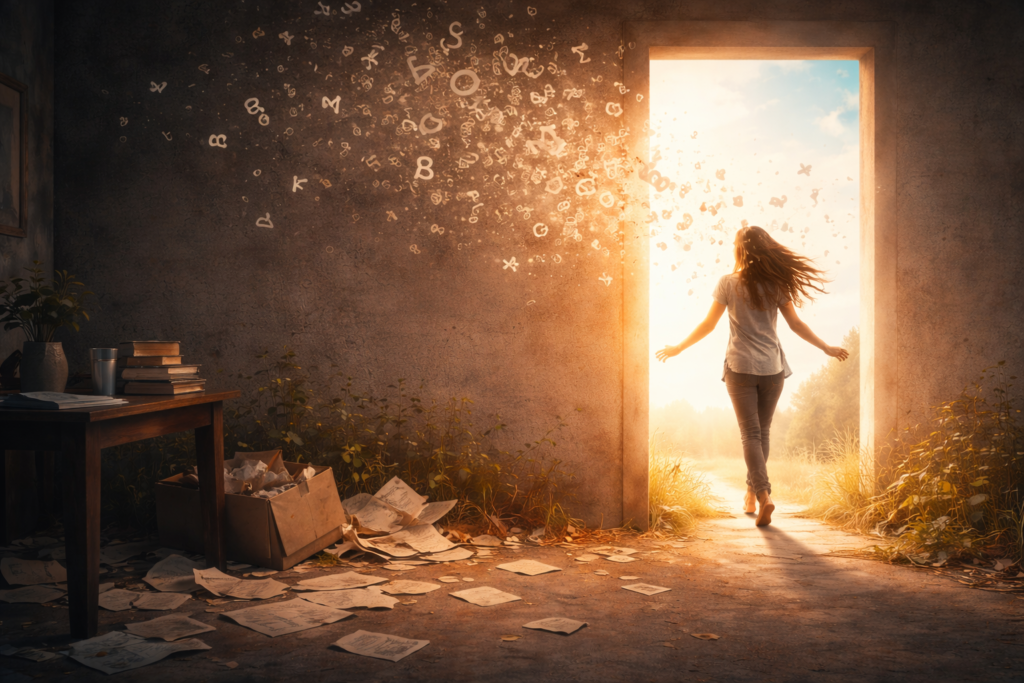
This is where outer language comes in. Language is the bin. Language is the door through which things can exit. When you can label an emotion, when you can put a word to it, its job is done. It no longer needs to live in the body or haunt the nervous system. It can move on.
But when there is no word, no name, no language, you are simply shoving another polythene bag into the next room of your brain. And that one, over time, becomes even more toxic.
Perhaps language is not meant to explain us, but to release us.
What remains unnamed does not disappear , it waits, settles, and slowly becomes structure, shaping how we relate, react, and retreat.
In that sense, language is not expression but movement, a way for inner life to remain fluid instead of fossilised.
And maybe freedom is nothing dramatic at all, but simply the ability to let experience pass through us without having to become it.


Leave a Reply to Mandeep Thakur Cancel reply