
Marriage is a maze.
No matter how much you prepare for it, you still find yourself standing in situations that make you wonder whether you prepared at all.
The first decade of marriage is particularly interesting. Most couples face some of their toughest storms during the first five years. Many go on to build healthy marriages, but those early years can be surprisingly difficult to navigate.
Becoming a parent during this period is like facing a tsunami in itself.
But marriage, with or without children, is already enough of an event.
It is not just a meeting with another person. It is an intervention with yourself.
The most amusing characters in this entire story, according to me, are the parents/elders of the couple.
Typically, anything good about their grown up child is attributed to the family. Any uncomfortable change, however, is attributed to the child’s partner.
It is exactly how things worked during childhood.
Anything kind, intelligent, or impressive the child did was credited to the family. Anything rude, rebellious, or unkind was blamed on a new friend.
It is as if the child has no nature of their own. And to some extent, that is true.
Children borrow heavily from the world around them. They imitate behavior before they develop a personal understanding of it.They are still forming their perception of the world.They observe, absorb, and experiment.
A friend, a movie, a teacher, a sibling, or even a brief interaction can influence how they behave, be it temporarily.
But while behaviors can be copied, feelings usually aren’t.
What children often imitate/notice is the attention surrounding a behavior. They notice what gets rewarded, what gets punished, what gets a reaction, and they learn from that.
But marriage is where this explanation starts becoming less convincing.
There is a general perception that adults become someone else because of the company they keep. After marriage, parents may think their child’s spouse changed them.
Partners often tell each other:
“You bring out the worst in me. I haven’t seen myself behaving like this before.”
I have a slightly different understanding of it.
I think marriage brings out what was always there. It just never had a vent.
From the kind of partners we choose to the ways we push our loved ones away, the things that shock other people were often present long before marriage. Nobody created them.
Marriage simply lowers the energy available to maintain a facade.
The demons were always there. Now they are sitting on the porch, giggling!
What I’m trying to say is that marriage is rarely something entirely new behavior wise on an individual level. Especially in its early years, it is a reflection of who we already are and the childhood and the family history we carry with us.
Marriage brings our vulnerable self to the surface. And to protect that vulnerable self, we do all kinds of strange things.
We become controlling, avoidant, defensive or critical.
The healthier we are emotionally, the healthier those reactions tend to be. The more wounded we are, the more dramatic they become.
So if you think your partner is being irrational, strange, or difficult, spend some time observing their relationship with their primary caregivers.
You will find a lot of answers there.
If they were never allowed to express their feelings as a child, they may now express them with overwhelming intensity, because this relationship finally feels safe enough to do so, or they want to define that boundary somehow.
Sometimes what appears as anger is fear looking for protection. They are frightened on the inside, so they become louder on the outside.
Some people even thrive on chaos and drama because chaos feels familiar. Peace feels foreign. Predictability feels suspicious. The nervous system often mistakes familiarity for safety.
If childhood taught them to shrink themselves around money, resources, or opportunities, they may carry that scarcity mindset into marriage and unintentionally pull their partner into it too.
Sometimes the opposite happens.
The more restricted they were growing up, the more expansive they became as adults.
The more silenced they were, the louder they became.
The more controlled they were, the more fiercely they protected their freedom.
The point is not to excuse unhealthy behavior. The point is to understand where it came from.
When you learn to trace a reaction back to the life that shaped it, many things begin to make sense.
That is why I think one of the most valuable things you can do in the first decade of marriage is to understand your partner’s life before you enter it.
Not because the past determines the future. But because it reveals the patterns that are most likely to show up in it.
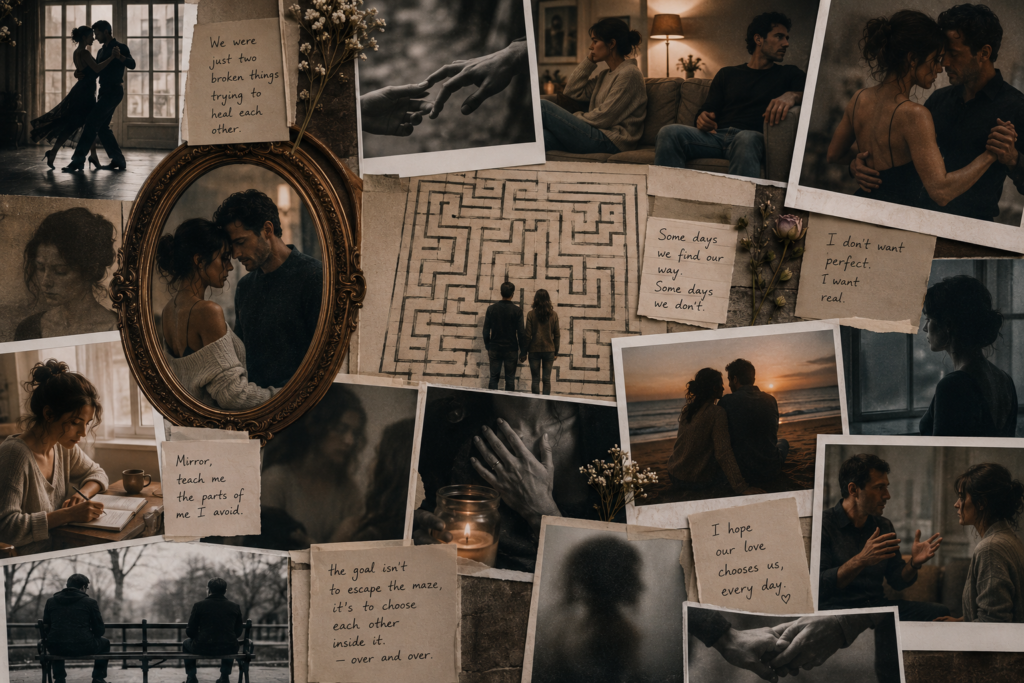
The longer I observe marriage, the less I see it as a union of two people and the more I see it as a meeting between two histories.
Two childhoods.
Two nervous systems.
Two sets of fears, hopes, wounds, and coping mechanisms.
The relationship simply becomes the place where they finally meet.
Marriage is the mirror.
Some people spend years trying to fix the reflection standing across from them. Others become curious about why that reflection exists in the first place.
Then the real questions begin.
Do you feel equipped to hold the wounds that still exist?
Do you have the patience to keep offering a mirror?
Are they willing to look into it?
All these questions can help you decide whether your partner can match the level of awareness you are at.
Because the most important question of all:
Are you willing to do the same with your own patterns?
Because marriage is not just a mirror for your partner.
It is a mirror for you too.
And sometimes the hardest reflection to face is your own.
If both of you are interested in finding and figuring out your own patterns, the chances are you will grow together but if only one of you is taking the burden of growing with changing times then it will look like driving a car with one tire bigger than the others, a marriage that is wobbly.
This is not a guide on how marriages work, but a nudge on it is more than what looks on the surface. It requires work.
The real work starts when we are ready and it may require professional help. Whether you do it for this marriage or the relationship that comes later (divorce or another romantic relationship or parenting), that’s a personal choice. But it will always help to learn how much of your behaviour is intentional and how much of it is a response to something at which you had no control.
In the end, marriage is a lot like a tango. It takes two people to create the dance, but each dancer is responsible for learning their own steps. We are not burdens waiting to be dragged across the floor. We are individuals learning our own rhythm, hoping to find someone willing to learn theirs too.
And when both people are willing to do that, the dance becomes beautiful.


Leave a Reply