Tag: selfreflection

  • The House the Brain Becomes

    Language is more important than we think.

    If we cannot speak, express, or label something, we cannot build the quintessential community every human being needs. And I don’t just mean the outer world communities like friendships, families, societies , but an inner world too.

    The inner world community is the harmony between the nervous system and all the other organ systems. It is the one that quietly decides our overall wellbeing. The one that decides what feels safe, what feels threatening, and what feels impossible to touch.

    When something inside us has no language, it exists in isolation.And isolation, even internally, is unbearable, and unhealthy.

    How it starts

    This usually starts during childhood. If we don’t teach children how to name what they are feeling, the feeling doesn’t disappear. As children, the world is new, and so are the emotions that come with it. Understanding them, naming them, and allowing them to be felt is a crucial part of growing up. It becomes a skill that carries through life.

    If humans don’t learn how to name their emotions, it can feel like being put inside a box they cannot come out of. 

    A box full of emotions

    Emotions are overwhelming by nature; they flood the body before the mind can make sense of them. And when there is no language to hold that flood, the only strategy left, especially for children, is to push it down. Acting out emotions is often inconvenient for the adults around such children, which makes the child feel unsafe expressing them. So they suppress it. 

    Not because suppression is healthy, but because it brings temporary safety and apparent relief.

    Over time, the nervous system learns this: don’t try to understand- just shove it away.

    Why shoving it down seems like nothing is wrong when actually everything is

    Shoving down often looks harmless. It looks like a distraction. Watching TV. Reading books. Staying busy. Overplaying. Oversleeping. Avoiding stillness. Avoiding people. Avoiding themselves. Talking too much or talking too little. We tell ourselves it’s alright, that it doesn’t mean anything, that it’s just passing time.

    But shoving down is actually like filling your brain with waste polythene bags.

    Each one feels insignificant. Each one polybag (emotion) light enough to ignore. So you keep adding them, telling yourself it’s fine, it’s nothing, you’ll deal with it later.

    The weight of keeping – the interior design of your brain

    One day, you open the bag and realise it’s no longer many small things. It’s one large, tangled mass of useless and not-so-useless things. Some of it you may have needed once. Some of it mattered at one point. But all of it has already done its work. 

    It has left its imprint on your nervous system – on how your body reacts, how quickly you get overwhelmed, how unsafe certain emotions feel without you even knowing why.

    If your brain were a house, you would eventually stand there wondering why you placed so many bags in one corner. They’ve taken up the space of everything else. The sofa. The almirah. The space to sit, rest, and live.

    The dilemma becomes absurd – should I remove the useful things from my house just to make room for this waste?

    The tragedy is not just that these bags are useless. It’s that they are toxic too.

    Even if each one is light individually, imagine how old they are. Polythene bags from vegetables. Milk packets. Clothes covers. Years old. Decades old. Rotting quietly.

    Just like emotions – decades old.

    When you finally start scrummaging through them, you are shocked by what you have kept, and why. And strangely, you don’t know what to do with it anymore. You don’t know where it belongs. You don’t know how to sort it. You don’t know why it’s still here.

    But the truth is simpler than we make it. Throw it. It is not your responsibility to preserve waste.

    Language

    They are not just bags but your emotions!

    Except emotions are not disgusting and toxic. They are meant to be met. They are how the body communicates safety, danger, joy, and connection. 

    Emotions are a language – one we must learn to understand.

    Learn to speak the language of emotions

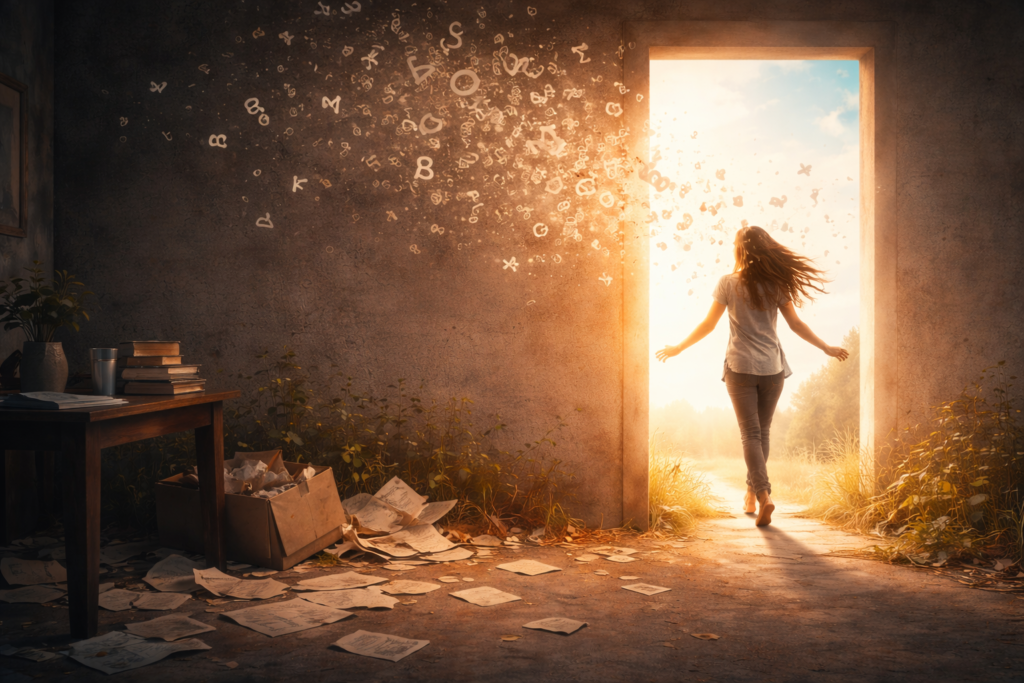
    This is where outer language comes in. Language is the bin. Language is the door through which things can exit. When you can label an emotion, when you can put a word to it, its job is done. It no longer needs to live in the body or haunt the nervous system. It can move on.

    But when there is no word, no name, no language, you are simply shoving another polythene bag into the next room of your brain. And that one, over time, becomes even more toxic.

    Perhaps language is not meant to explain us, but to release us.

    What remains unnamed does not disappear , it waits, settles, and slowly becomes structure, shaping how we relate, react, and retreat.

    In that sense, language is not expression but movement, a way for inner life to remain fluid instead of fossilised.

    And maybe freedom is nothing dramatic at all, but simply the ability to let experience pass through us without having to become it.

  • How I Learned to Enjoy the Life I Already Have

    “He who knows that enough is enough will always have enough.”
    Lao Tzu

    Scarcity breeds two fears: the fear of never having abundance again and the fear of losing what little you already have.

    There is a Taoist saying, “He who hoards much, loses much”—be it worry or money, I would say.

    This isn’t a note from a financial maestro advising you how to save or spend, but a reflection from someone who believes in thriving mentally, despite the economy we’re living in.

    The fear of abundance means expecting never to find wealth, health, time, or love again, whatever you once lacked.

    This fear can appear as the urge to clutch tightly what you have, no matter how little or much that is, and sometimes it shouts through a vulgar display of excess, stretching your own limits until it backfires.

    The wound that never heals

    This scarcity mindset may be either first-generation or multigenerational. It may have begun after an earthquake that you, or perhaps your grandfather, survived. It could be because of a major event that you or your family went through, something that’s long over, yet still vivid in memory.

    Scarcity trauma can also exist at the community level, even within religion. It may be local or far larger than you think, depending on how many people lived through that catastrophe.
    For example, the trauma of Partition or war is multigenerational and shared across vast regions. It changed people once and for many generations after.

    Sometimes the trauma is not because of any major catastrophe, but as the elder child you were told never to spend a lot, curb your wishes because your father did not make much. You were taught to give up on your wishes because that meant good for the family. You were forced to grow beyond your age.

    Whether that trauma makes you a spendthrift or a tight-fisted person depends on various factors. You may follow the YOLO (“you only live once”) approach or save for the rainy days, sometimes even for your 7th generation.

    The point is, no matter which approach you follow, both are extremes.

    Easier said than done, yes, but if you notice that you’re unhappy either way, whether as a super saver or a super spender, then you’re suffering. You are either always living for the moment or always waiting for the “big day” to enjoy, a day that is not coming anytime soon.

    The brain can’t feel what it never did

    You lash out at your family over a small purchase, fearing the loss of all you have. You lose sleep thinking about that catastrophic event recurring. You try to control every decision, yours and others’ to never “let go.” You might hide financial details, or you may have developed a sharp temper.

    On the other side, the over-spender spoils everyone or only themselves selfishly, like a revenge on the older times. They buy a fancy phone because they never had one but deny their family the abundance, fearing that generosity will invite more demands, which will ‘spoil’ them.

    Some buy endlessly for others, mistaking spending for love, raising a family that doesn’t understand money or its meaning. One wound endured while another wound created.

    Whether you hoard or overspend, you’ve likely become friends with the “not feeling happy” way of life.

    And while you are unhappy, remember that those who depend on you, live with you, or love you are unhappy with you too.

    Is this pain real or is your brain still defending you?

    No one is denying your pain! It happened; it surely did! But what you do with your life now matters just as much.

    One reality is that the traumatic event happened, that phase you had to endure. Another reality is that you are doing well today. You have someone you can care for today. And even if it isn’t someone else, it’s you whom you can care for, in a healthy way.

    I’m not asking people to go big or go small, neither to save it all nor to spend it all. I’m asking for objectivity.

    Reconsider how you manage your finances:
    Is there a heavy feeling of fear, shame, guilt, or regret behind it?
    Is it fair to put yourself through this pain?
    Is it fair to deprive those who depend on you or to never teach them how to handle money with balance?

    Neither too much nor too little—just the art of balance.

    Living in circles

    Ask yourself: Is living in the future or the past worth wasting your present?

    People living with the fear of scarcity often forget that the brain remembers not only the past but also the present. The life you’re living now is being inscribed in memory every day, telling your brain how safe or unsafe you are.

    Many people say, “I’ll save up for that big vacation,” and wait ten years before doing any other thing to make themselves happy. And finally, it happens.

    But what also happens is the void that follows.

    The happiness lasted only until the dream became real. And when the time to enjoy came that vacation, they couldn’t. They were never used to enjoying anything, not even a simple visit to an ice cream parlor.

    The dopamine of waiting faded once they arrived. But the other chemicals of happiness, the ones that make you feel joy and relaxation, did not flow, because they were never did. The body doesn’t feel safe enough to relax and experience happiness.

    Overwhelmed by emotions, they might cry, fight, freeze, or leave, not because they don’t want joy, but because they no longer know how to handle it.

    The tyranny of right moment that you missed

    Sometimes it’s the age, the situation, or the people you are, or aren’t with.

    This is when you should realize that certain things make sense only when done at the right time. No amount of money or power can recreate the happiness that needed the right moment and the right people.

    A trip at 21 to an abandoned fort with your friends, funded by pocket money, feels entirely different from a trip at 40 with colleagues to a five-star hotel in a premium city. It might look great on social media, but it does little for your soul.

    The small Saturday ritual of going on a long drive with your family, eating your favorite snacks, and listening to music will do far more for your nervous system than waiting until 50 to travel to New York with kids who have grown up and grown apart.

    Nobody can enjoy life as a family that never learned to enjoy together.

    It’s not the destination, it’s the objective, the process, the practice for the big thing that matters more.

    Imagine out of fear, despite being able to afford more, you always wore inexpensive clothes or ate only at cheap places. What happens when you finally wear a beautifu expensivel outfit or are invited to a Michelin-starred restaurant? In both cases, you’ll feel out of place.

    Out of shame, you might fidget and eat nervously. Or, trying to overcompensate, you might flaunt your money and behave as if you don’t belong there. You will feel like an imposter.

    Either way, you’ll look like someone unaccustomed to this, not just outwardly, but inwardly.

    The point isn’t appearance; it’s your ability to genuinely enjoy what you always wished for.

    We can live, a little everyday!

    That’s why you should stretch a little, in terms of both time and money, for yourself and for your family and friends.

    Keep yourself accustomed to being happy. So even if you never reach your final goal, you’ll have enjoyed the process so much that it won’t matter anymore. And if you do reach it, you’ll enjoy it even more, it will feel truly worth it.

    So live a little every day. Eat that fancy ice cream. Buy that nice watch. Take a day trip to a resort. Get a comfortable chair for your work desk. Hang good curtains in your room.

    Do one good thing every few months that feels slightly out of your budget, just to remind yourself that you can make it.

    Spoil your family a little. Tell them, “We have enough, and we’ll have more, but we’ll enjoy what we have, even if we don’t.”

    Don’t mock those who spend or those who don’t. Stay true to what you can and can’t do. Don’t become a crybaby of jealousy or insecurity.

    And finally

    Tell your brain: All is well. All will be well.
    You are allowed to be happy right now, with whatever you have.

    There is no fixed criterion for happiness, only a mindset.
    And if the heaviness returns, remind it gently that,

    You’re strong enough to handle it. You can make it work.

    Trust the process, and keep going.

    And this makes me think of Philip Doddridge when he said,
    “Let us live while we live.”

  • Emotional Cushions and the Art of Living Well

    I am reminded of a quote by Booth Tarkington as I write this essay:

    “Cherish all your happy moments; they make a fine cushion for old age.”

    Mr. Tarkington and I have probably understood the miracle of a cushion in our lives.

    A cushion is something you need when you lean on something. While we are familiar with the aesthetics and physical comfort a cushion brings, we must also realize that we have other kinds of cushions too.

    The emotional cushions, as we may call them.

    A song could be your cushion after a hard day at work.

    A slice of pizza could be your cushion after a tiff with your parents.

    A glass of something cool could be your cushion after a setback at work.

    A two-hour movie you’ve watched a hundred times before is your cushion when you feel a little lonely.

    Your favorite book is your cushion when reality feels exhausting.

    Looking at old photographs is your cushion when you’re feeling homesick.

    Sitting on the balcony with a hot cup of coffee is a cushion when you miss the good old days.

    A chat with a friend is a cushion when you feel unloved.

    A dance routine you always turn to when you’re too much in your head.

    A rap song you sing verbatim when you’re feeling demotivated.

    An hour with your favorite sport brings you back to life again.

    Becoming a part of a community where you share a common interest or goal can be a cushion when life feels worthless.

    Even a small contribution, a kind gesture, an offer of help, can remind you that you have a purpose after all.

    All these are the cushions we keep in our lives and take out as and when we need them.

    Some may just be lying around, like cushions in your living room, catching your sight and comforting you unknowingly.

    Need Of Bigger Cushions

    A vacation. A Vipassana break. A retreat. A sabbatical. Or a reunion with our favorite cousins. These are some examples of bigger cushions, when the shock is bigger. We need more time to lean on and find comfort in our cushions to recuperate.

    Why We Need To Stitch New Cushions Every Now And Then

    We also need to build a habit to stitch and find our new cushions. You see, we have new emotions, newer shocks, newer issues to ponder upon. 

    The older cushions may not fulfill all our needs. Hence, we find new cushions based on our new requirements, yet not abandon the older cushions. They all serve a purpose, they all provide comfort this way or other.

    Learning a new skill like knitting or taekwondo. 

    Starting a blog like this. 

    Finding a new way to exercise. 

    Seeking a spiritual guide, or even a new faith. 

    Taking breaks from people and jobs to build a new home within yourself.

    Instead of children, we may choose pets and plants to care for. 

    We may become part of a community that helps the disadvantaged.

    This list is long, and it should be long. 

    Why We All Should Become Cushion Collectors

    Cushions come in different forms and sizes, depending on the emotional need they help with. One cushion can’t serve all needs. Nor can you carry the same cushion everywhere.

    That’s why you place them in different corners of your life, so they’re always within reach. 

    You never feel the rush to run home for comfort, because there’s always a cushion nearby.

    This list of cushions should be a work in progress, always growing. Life will not tire of throwing new setbacks and shocks at you. So you must be ready with your cushions to handle them better.

    Let your life look like a cozy room, full of your favorite cushions.

    And may you find the fluffiest one, in your favorite color, very soon.

  • In a World of Shadows, Find Your Sunflower People

    A very interesting time to be alive.

    We’ve discussed it often, practiced it daily! Removing toxic people from our lives, like garbage, never looking back. Even though it never feels like garbage, it feels like taking a knife out of your wounds with your own bare hands. It might feel like taking out your heart and squeezing it to bleed, till you don’t feel anything.

    Once you have found the courage to move on, eventually life would become peaceful.

    Wonderful. But what next?

    A lot is said about what not to do. How not to put up with toxic behaviors, how to leave a room that doesn’t respect you, how moving on is better than staying. It is inscribed more like a warning than a suggestion. But what is never discussed is what to do later, and why.

    Many of us were raised in toxic families, only to find ourselves in toxic marriages and friendships later in life. Like a loop, or living in a constant shadow of misfortune.

    We often repeat the mantra: “It’s better to be alone than with toxic people.” But is that really true? Can we truly make it without people? Can we remain our true selves, without having anyone, neither toxic ones nor the good ones in our lives?

    Enter the Sunflower People 

    Yes, you shouldn’t tolerate toxicity. But sometimes, you simply can’t abandon certain people. You can’t step out of the constant hurt that you have to face, you don’t know what to do except for dying when you are looking for a room to breathe.

    So what is the solution? Can we step out of this loop of loneliness? Can we still be happy after leaving who needed to be left? Can we still feel supported during our times of struggle where we can only endure but not stop?

    Yes absolutely! And that’s why it’s important to cultivate and cherish your sunflower people, after removing the cactus people from your life. They even matter when the garden of your life has all kinds of plants, sometimes with thorns, sometimes with flowers.

    Sunflower people bring light to your life on the darkest days. They are your chosen family. The ones who energize you just by being around them.

    These are the people you must search for, keep holding on to, and never stop appreciating their presence in your life. Don’t stop at one such person! Be greedy! Keep decorating the bouquet of your life with such beautiful and pure people. The more sunflowers, the more beautiful and peaceful it becomes.

    Why They Matter

    Sunflower people give you the energy to face toxic situations. They fill the void left by hurtful ones. They remind you, daily, that you deserve better. Their presence in your life is a testimony that you matter and deserve to be loved.

    They show up in different ways:

    Some you talk to every day.

    Some you meet once a year.

    Some you know digitally/virtually.

    Some you haven’t seen in a decade.

    They don’t all look the same, but they share one thing: they heal you when you connect.

    You regain the strength to face the world again.

    They make your clumsiness charming, your silliness memorable. They remember your little quirks, maybe even your favorite drink. They let you be imperfect in a world that demands perfection. And they always know how to hype you up when you’re down.

    The Gift of Chosen Family

    Not everyone understands this, but building a chosen family is a masterstroke of luck. To handpick the people who surround you. To find your home in others, when you’re lost in life. That is a blessing.

    Be the home to someone. To find your home in someone.

  • From Horoscopes to ChatGPT: The Human Need to Be Seen

    ChatGPT (and similar LLMs) proves something simple yet profound. It shows us that validation, encouragement, and understanding matter deeply to us as human beings.

    Despite knowing it’s an AI, a machine, not a “sane human” talking, we still believe its kind words. We want to hear praise, to have our fears and feelings validated. And we keep coming back for more.

    This shows an interesting phenomenon: the human brain is wired to be seen and heard, no matter who it is from.

    Why Kind Words Matter

    Throughout history, humans have been drawn to psychology, astrology, tarot, and numerology. Some followers turn to them to know the future. But many simply want to feel known.

    Think of any sun sign or name-based reading. Beyond predictions (rolling eyes), they usually describe personality traits like strengths, quirks, weaknesses. And most of the time, they emphasize the positives.

    People end up hearing things about themselves that they may never have heard from loved ones.

    For example:

    “An X sun sign person is sincere and disciplined. They are go-getters, ambitious, natural leaders, and liked by all. They are charming and reliable, though sometimes impatient.”

    Now imagine reading this the day after you failed at something. You might mock it. You might not believe it. But somewhere, it makes you feel better. You reread it, just for that comfort.

    Because often, those who seek such words are people who never got the kind words they deserved.

    The Power of Words from Loved Ones

    Now imagine these same words (true or not, who knows) spoken by someone you love deeply. The impact is undeniable. You may even start embodying them, because the person you love sees you that way.

    And yet, in many cultures (especially South-Asian ones), we undervalue the role of words. We think love is enough. We believe in actions, sometimes not even that. Sometimes we assume our mere existence is enough.

    But technology and psychology, especially therapy, show us otherwise. To be seen and heard is healing.

    Maybe that’s why confession (in Christianity, with all its spiritual significance) feels healing. Even unseen, a person speaks, and a person listens. That act alone is powerful. Our words become more important than our physical appearance and actions.

    Maybe that’s why cultures have speeches for every occasion. Why a eulogy matters so much. Does the dead wait to hear something at last, before moving on peacefully?

    Finding Words, Finding Healing

    In the end, there is an easy way and a hard way to live. The hope will always be to find people who give us space to speak, and who find the right words to whisper back when we cannot hear ourselves in the noise of life.

    But until we find them, I am okay with ChatGPT being my friend, philosopher, and guide.

  • When Life Feels Like a Panic Room

    Behold this image!

    A surgeon after performing a 10 hour surgery, comes out of the operation theatre. He takes a sigh. Things are still critical. But he doesn’t give these expressions when he is in the operation theatre, where everyone is looking at him for his work and prowess.

    He also doesn’t show his pauses in front of the patient’s relatives. He does it when the people who look up to him, can’t see him.

    He doesn’t want them to shake their confidence in him.

    He probably wouldn’t even have felt like sighing when he was in the operation theatre itself. The pressure wouldn’t have let him relax or take a short break just to realign himself at all.

    So, in the same way, you don’t sigh inside the very room where the problem lives.

    Imagine there is a heavy discussion or argument going on, you are sort of the neutral person or the unsaid umpire of the situation. You are swept up in all the heavy emotions in the room that demand your 100% attention.

    But it doesn’t mean your nervous system isn’t asking for a break. We need time to realign, process and ruminate our thoughts. That small sigh is an example of a short yet significant break.

    When we are in the room with the red light on, we may not want to tell people that there is something critical going on, through our expressions.Lest, they might get nervous and tense even more.

    We may foresee bigger trouble ahead, but we hold the calm of the room intact before dropping the weight of heavy information.

    And sometimes the situation is so urgent, you can’t imagine anything else, but to remain present in that situation.

    But something happens when you step out of your frame of reference. Something changes significantly, even for a second.
    Something which was mentioned by Daniel Kahneman, in ‘thinking fast and slow’. The moment our frame changes, mostly it’s the panic room itself, we suddenly become aware of the heaviness.

    There is heavy weight on our shoulders but we also feel we can put it down, for a bit. Before we could find the courage to put it back up again.

    Maybe that’s how being in a tough phase and getting through it feels.

    When we are in it, we can’t catch a breath. We are so deep in it, we can’t think of anything else in the world. It makes us panic and lose our strength, bringing us to our wits’ end.

    But is there something which can temporarily fix this frame, just like stepping out of the panic room?

    I think those transient breaks are people/friends/family. It could be a hobby, it’s a vacation. Sometimes work too!

    It could be a book or a movie or a night of standup comedy!

    Something or anything which lets you dissociate and detach from the imminent problem, for a bit. Something which gives you a chance to feel yourself, process the situation and your emotions about it.

    This change is pertinent for your emotional resilience. Yes, we are built to last. But we are not built without pit stops.

    When life feels like a Panic room, you need a break. #thoughtsdenbyneha

    We need to recharge. Maybe the capacity of everyone is different.

    We still haven’t been able to make a perpetual machine, let alone a human body!

    Do not hesitate to catch your breath. When going gets really tough, step out of your room.

    Yes, you have to step into it again, eventually, but recharging before going in, might give you a fresh set of perspectives and energy to solve the situation in the room again.

    What is life, if not a vast healthcare center!

    At any given time, some room is always blinking, asking for help?

  • Jealousy: The Villain or The Mirror

    Jealousy walks into our lives quietly, like an uninvited guest. It doesn’t shout at first. It lingers in the corner, watching, comparing, whispering that someone else has what we don’t.

    As children, it may start with toys or attention; as adults, it shifts to success, love, or recognition.

    Yet the emotion is the same. It is raw, uncomfortable, and deeply human.

    The real question is not whether jealousy visits us, but what we choose to do when it does. Should we deny it, let it poison us, or learn to understand the truths it is pointing toward?

    My observation is we feel jealous only in certain types of situations. And it has some markers and with some inner work we can get past it, if we can organise our thoughts around it a bit.

    1. The distance factor

    Our degree of jealousy depends on how “close” we feel to the person in question. In a way, it shows in which league we put ourselves.

    For example, jealousy usually hits harder when the person is closer to our own life situation. They probably have a similar job, from a similar educational or financial background, same hometown, same social circle etc. Something which puts you in a pretty similar opportunity category, seemingly. That’s why siblings/classmates/cousins/colleagues often feel jealous of each other.

    But if the distance is too big, jealousy shifts into admiration. Think of a gully boy admiring Eminem. He knows he can only admire him, not join his league. But another successful musician, closer to Eminem’s level, might feel more jealousy than admiration.

    We often see how celebrities are jealous of each other’s success. A small kid would admire Meryl Streep, but a leading actor of Bollywood would probably be jealous of her.

    So, when the gap feels too wide to cover, we admire it. When the gap feels bridgeable, we get jealous.

    1. The “not earned it” trigger

    We also get jealous when we feel someone hasn’t earned what they’re getting. If it looks like they’ve been handed success, attention, or praise they don’t deserve, jealousy rises.

    Probably that’s why nepotism hurts so much. You feel you have the same set of skills and talent, but just because of one extra blood relation they are chosen, not you.

    Now, if we could acknowledge struggles or see the effort behind someone’s achievements, for example a dear friend, then even when they’re in the same league, we’re more likely to respect them, maybe even encourage them, instead of resenting them.

    The acknowledgement of struggle also comes from a place of empathy and security. If we were raised to be kind, then we would notice the struggles and would admire the hard work someone does to achieve something similar.

    1. Low self-worth

    A big root of jealousy is low self-worth. If I feel jealous because someone else is called beautiful, inner work will show that I’m dissatisfied with my own looks.

    Deep down, I think, “This person has the same flaws as me. Why don’t they feel the same inferiority as I do? Why am I not being praised like them?”

    When we see them coping with their insecurities, it reminds us of our own failures, and we lash out as jealousy.

    This is why having a clear sense of self and clear definitions of concepts like happiness, beauty, or love is so important. If you truly believe everyone is beautiful in their own way, including yourself, jealousy naturally decreases.

    So, the moral?

    Let them be. And you be you. Use jealousy as a marker of what you think is missing, instead of projecting it on others. The more secure you are in yourself, the less anyone can touch you.

    1. Seeking approval and comparisons

    Jealousy also spikes when someone we seek approval from compares us to another person, who we do not think we are similar to at all. Maybe the comparison isn’t even valid, but because their judgment matters to us, we start competing with the one they held against us.

    The real question is: why do you need this person’s approval? Are they qualified to judge? Mature enough, despite the age and status? Do they even understand your journey? Have you lived similar lives, with similar struggles and opportunities?

    Often the answer is no. Yet we still let their comparison sting us.

    The most common example? Cousins, neighbours, colleagues. But are we really that similar? Should we let the cognitive bias of the comparer define our worth?

    It’s like asking: should elephants really care what ants say about them?

    This happens within families a lot. We are compared to a sibling or a distant cousin, and are constantly shamed for our struggles and failures. We feel hurt by our parents and elders for not recognizing our life situations, and shaming us, to apparently help us.

    We are shamed despite being successful by all social parameters, for a thing which doesn’t make sense, except your elders.

    Startup founders, even after being successful and accoladed by one and all, are shamed by their elders for not clearing government jobs, because success for them is a blue light car (although banned now).

    Shaming as children it only increases resentment towards parents, and sometimes even that person we are being compared with.The jealousy sometimes puts distance because of the constant comparison. We would probably want that person who we are being compared with to show our parents their flaws too.

    We want to tell our parents nobody is perfect, especially the person they think.

    My verdict of this situation is, what if our elders are really not that smart? What if the lens they think they are wearing to assess our life is outdated, broken and damaged? Why should I think my parents or elders know everything better than me? What if they are really wrong in some of the cases?

    It doesn’t mean they are not worth my respect, it means I shouldn’t take their judgements seriously and reiterate it to them now and then, that what they are doing is not helping but damaging their child’s peace.

    All in all

    Maybe jealousy isn’t the villain we paint it to be. It is a mirror. Sometimes harsh, sometimes painfully honest. It is showing us where our longings hide. For children, it can be a chance to learn fairness, gratitude, and patience.

    For us, it can be a reminder to turn inward rather than outward, to ask what is missing in our own lives that we keep measuring against others. If we are jealous of someone traveling a lot, then proabably we should also try to book our tickets too now and then.

    If we can hold jealousy gently instead of fearing or denying it, it stops being a shadow and starts becoming a guide, on our journey of self awareness.

  • Be the Ancestor Your Children Will Thank

    As an adult with a family, if your version of devotion of parents is to follow their life to the T, not changing your lifestyle or locations, mimicking their (unhealthy) life, routine, financial and social choices etc. and expecting your family to do so too, then this stream of thought is for you.

    Ask yourself would you still eat raw meat, just because your ancestors ate in their times, which they did, (they had no knowledge and option).

    I don’t think so!

    That’s because you are already exposed to cooked food (with fancy spices and all), raw veggies and fruits (you need your fibres babe!) and just more hygienic food. We still can’t win against all the pathogens you see!

    You would not eat raw meat for one main reason it could be unhygienic, with disease carrying germs. And, though I am a vegetarian, I assume it would be difficult to chew in the first place. 

    The exposure to better food, cooked food came from knowledge, the growth of civilization. While we respect the difficult old times, we would prefer moving with the times and continue to make better and learned choices. We are already teaming up against processed foods and sugar!

    Now, if at all your love for your parents and ancestry suggests you to follow them without considering the consequences of it on yourself and your family, whether it hampers your child growth, safety and future opportunities, then you my friend are a blind follower!

    You were raised through manipulation and by selfish, insecure parents who can’t think beyond their own needs, unintentionally.

    One would think if everyone else, a plethora of people are making it in the older ways then we can too!

    First describe ‘making it’! If you are unable to chatgpt it!

    Also, this just shows how devoid of critical thinking we are. Not everyone has the choice, but if everybody had an option, then you know the answer.

    As a fan of Interstellar, one thing always stayed with me. Cooper (played by my favorite Matthew McConaughey) promised his daughter Murphy (played by Jessica Chastain), not his father, Donald, that he would come back. And, it was the daughter who trusted his father that he would keep his promise, such is the amount of trust children expect/have on their parents. Cooper became the ‘parent/father’ we all need and worship.

    Now, inarguably the first rule of parenting is what is best for my children, because you brought them into this world. Period. It doesn’t matter if you don’t believe the nuances of psychology but God of every religion is exactly doing that for us, His children, the best in every way possible. You can’t fight this fact in any realm, Earth or spiritual.

    There is no other relationship which requires your accountability as this one does. Everything else is a seasoning in the pizza of life. 

    Our great grandparents probably used the same method on our parents. To bind in mental chains, something that one can’t break easily without feeling guilty, despite knowing they are right. That’s how blind cults are made, that’s what an insecure leader would do, emotional blackmailing.

    To keep the flock together, you bring a dog of manipulation and guilt, the fear of abandonment and failure, and even a rational thinker strong sheep would be afraid to leave.

    There is nothing more selfless than raising a child. Making changes in your life for your children is an act of bravery and hope. It sends a message to the society that we matter. These children are the future adults, they will learn it is always human first, material second.

    No amount of wealth can equate the bliss of your people, healthy and thriving.

    Any ounce of people pleasing is detrimental to a child’s growth. Not only as a parent you would make wrong decisions but also your children will also learn it from you.

    They will learn that appeasement is more important than logic, that the past is more important than the future. That, the facade of happiness matters more than real happiness, that we as humans matter less and theatrics matter more.

    Any logical reasoning in this context, for the present and future (children, partner) and the past (parents), will nudge towards making difficult decisions.

    For example, imagine you left your village where your parents and their parents grew up, for better job opportunities. And today, whenever you visit the village, you compare lives at both places naturally. The village hasn’t changed much and still doesn’t promise an overall good life, except a feeling of hometown and nostalgia.

    In the context of the future, it is highly likely you would prefer a bigger city with the hope of better infrastructure, education possibility, healthcare and your own job. 

    This is not against the village! This understanding, if things are not attuned to your present and future needs, if you can’t cater to your loved ones’ needs, it is better to move on from anything non-living. 

    Yes, you can still love your hometown, but you answer your posterity now, not your ancestry (it will be weird if you can).

    You are the ancestor your kids would talk about. The ancestors who made grand changes are always revered more, if that gives you a high. 

    And, even if there is no one praising you and if your family’s health and happiness is ensured, take those decisions, whatever that means. 

    Family means everyone, parents, partner, and children, whoever is dependent on your decisions.

    If their happiness requires moving to the moon or mountains, to the beach or the desert, Move!

    It is entirely up to your family, but in no way a flimsy excuse of love of a place is enough, it has to work out in all scenarios.

    No love is big enough to help you just survive your things.

    Human potential reaches its zenith when it is thriving not surviving. 

    The choice Oh learned (Wo)Man is yours!

  • Love with its sweet fangs

    What made me wonder?

    I watched a movie with Daniel Day Lewis, ‘Phantom thread’. The phrase in itself means, one keeps sewing even when the actual thread has finished, with phantom thread. The machine keeps running on an invisible thread. Hence the story possibly reflects ghosts of past relationships and traumas and how they are affecting the protagonist’s Reynolds Woodcock (played by Daniel D Lewis) present life.

    The movie talked about how his interest in his partner/muse only remained till that partner could care for him on his sick days. Needless to say he had one too many muses and relationships. Anyway, he despised becoming vulnerable, was a workaholic and would let his partner go when he felt his life and routine were getting disrupted.

    But this particular partner (Alma, played by Vicky Krieps) somehow showed him that it’s the vulnerability he has to stop avoiding if he wants the full bliss of love. He did like being in love and his understanding of being vulnerable in love paved the way for a stable relationship. At least this is what I understood from the movie.

    (Mild spoiler alert) Some say he was poisoned in the end willingly, by his partner, because he felt it was better for him to die than bearing such vulnerability to be in love. He could have inflicted control on his partner, yet he chose surrender to his fear and died.

    Whether literal or symbolic, it showed the lengths some go to avoid vulnerability, even if it costs them love. Anyway, watch it yourself if you want to explore it more.

    Wound is where the light enters, as they said!

    To some people this awareness of vulnerability that was discussed in the movie Phantom thread, is the basis of any loving relationship. But the dependence that comes with it, some people truly want to avoid.

    They have never found trust in their life or have been hurt so much, their vulnerable bones have deteriorated. Hence, they leave when they become too dependent on the other person, with the fear that they might be disappointed.

    This is probably why Reynolds Woodcock (played by Daniel Day Lewis, in Phantom thread, the lead character) preferred unstable relationships and eventually death in the end, over trusting someone.

    He probably had an avoidant attachment style, along with other emotional wounds from his childhood.

    Some facts to munch on:

    For context, the attachment theory states:

    Anxious lovers often seek purpose through saving/protection. The purpose keeps them relevant in the relationship.

    They in turn seek closeness and constant reassurance, want to fix others, and fear abandonment. They may prioritize the relationship over their own needs just to keep it intact.

    Avoidants often withhold care and emotional availability to avoid needing. They want their space and avoid becoming dependent on someone.

    The savior role (we would be talking about it in a bit) becomes a safe way to be close because it keeps the avoidant person in control. They’re always the giver, never the receiver. Vulnerability stays one-sided. They tend to pull away when things get too close. (Our dear Woodcock probably preferred dying over being in a relationship, so deep was his wound.)

    So what is love, can I dissect the hell out of it?

    The ability to be vulnerable in front of the person you love is not the only cornerstone of love, but there is something more interesting, protection.

    Love in its most innocent form, needs someone powerful. A savior, like a child’s love for the parent.

    And in the evolved form or maybe the ultimate form it may be the parent’s love for a child, or love for an animal or someone who is unable to protect itself. Because it reminds them of God. At least that’s what my understanding of love is, as of now.

    You love a child (or a pet or a plant or any being) because you want to. Because their being/presence enables you, nourishes you and soothes you. You will move mountains to nurture them.
    Isn’t it probably the form of love God has for us?

    Understanding the OG God and love

    What if God, after all His omnipotence, longs for a love free from His powers, a love He didn’t have to earn?

    If love is about reciprocation, what if God is craving for a love like a child where He would be loved beyond His power, just for His being.

    Is God waiting for someone to cradle him, since he’s tired of taking care of us all alone?

    But what if it is a saviour complex I’m talking about? Is it my need to feel powerful?

    Is it otherwise possible that I develop a kind of love where God and I mutually care for each other and protect each other?

    Would I hurt God’s ego by asking Him to let me protect Him?

    Is it possible God neither wants to be worshipped or cradled but canoodled like equals?

    This is all on the basis of the assumption that God is as much part of our emotional realm as other beings. It is we who are treating Him as an outsider, over and above it, but what it’s not something He wants.

    Also a note, I use ‘He’ for God because I assume Him as someone who identifies as a man. You can imagine whichever pronoun for Him. I’m pretty sure God is a pretty chill and fluid being.

    Coming back to the Earthly realm of mortal men and women

    This also makes me wonder, why men-women relationships are so much about protector savior dynamics. Evolutionary, it was the need. The male was protecting the female, the provider and protector of the mother of his children. Perhaps that’s the origin of masculine protector energy, rooted in evolution, not essence.

    But today, do we still need that dynamic? Haven’t the definition of protection and saving changed?

    And if we are talking about loving God too, do we need that protectionist savior complex from Him? Or is that how I should check the love God has for me, whether He is protecting me?

    Yes, the reality is that the world is full of harshness that we need protection from. The person who loves us should do everything to protect us, but is there a possibility of a relationship where nobody needs saving. A relationship where they don’t define their partner as someone who has saved them or protected them.

    Now, we don’t confuse support/help/assistance with saving/protection here. In a relationship, typically out of love you like to support each other in whatever way you can.

    But saving/protection can easily be pushed into the realm of a favor, something to be grateful for. And that is not a healthy dynamic where one partner is constantly grateful to the other, as if they are needy and disadvantaged. Because that’s like charity, not love.

    What if I don’t like the hero, but the scaredy clumsy side character?

    If we do agree on love of equals, can we let damsels in distress be in distress? Help them in another way, other than being in love with them because they need rescuing.

    Why should you rescue her from her distress then go on to fall in love with her? Or the only reason you rescued her is because you love her ? Does vulnerability attract you?

    Is it some kind of trauma-bonding (google it to understand more) or love or savior complex?

    Do I love people because I see their pain, or because they allow me to be the healer?

    Although I can’t take away the fact that I want to elucidate all the pain the person I love has, because I can’t see them in pain.

    But does it also mean, I’ll only want to be with the person who has some pain I need to help them with, so that I am relevant in their life?

    Thanks but no thanks!

    It makes me wonder, is gratefulness the only way love in an amorous relationship could last?
    What if love didn’t need to be earned or repaid, what if love could just be?
    Is pain and protection the cornerstone of attraction? What about peace as the cornerstone? What about respect? Playfulness?

    Is it healthy and real to have pain and protection as the center of a love relationship? Isn’t that more like a parent-child dynamic, in a purely adult relationship?

    Why when you are having second thoughts about a person, society comes up with excuses like who else will love you in your situation, like love is not love but a favor. We should be thankful for the protector to save us and then call charity as love.

    At least if we call it what it is, then we can attune our behavior accordingly. We would know it’s not a relationship of equals who want to be with each other, but more like a charity case, master and his rescued slave.

    Also, what if the person you love is incapable of protecting anyone, even themselves, should that person not be allowed to be in love?

    Why even a slight difference in any characteristic of the person, makes them a not so ideal choice to be loved?
    People who fall in love with people (who are different from ‘normal’ in any way, their background, physical and financial characteristics, social standing), are glorified for being big hearted.
    But what if these human-gods were actually not that cool, and formed this relationship just because they could be glorified and worshipped.

    Another god complex in making.

    But doesn’t that also mean God shouldn’t love us, because we are in front of Him as frail and weak as an infant, living at the mercy of others?

    Does even god not love me just for my being?

    Marry me because I want our love ruined!

    Amorous love when it is turned into marriage is often compared to how capable both the people are, calling them power couple and what not. When we know nobody likes being pitied, marriage is one where one of the qualities acquired to have a long relationship is pity, not compassion but pity, to be accepted by the one who is not so perfect. At least that is being taught to us again and again.

    But does love really need a set of characteristics, a perfect image, a kite with a flying thread? Why do we want to define marriage with who is dependent and who is the protector? Typically the Male is a financial provider and Female everything else. That’s the image society wants to sell at least.

    Girls are typically brought up with this mindset, that a boy, the person who would love and marry would be rescuing her from whatever she is struggling with in her life.
    That she is incapable of saving herself, or shouldn’t rely on her friends or support, but a white knight with shining armour/ a tall dark handsome/ a man who has taken therapy.

    We usually marry our mirror images or polar opposites. It is not like dressing up complimentary where the top has to match the bottom but more like a puzzle, which just fits.
    Because if they are complete on their own, do they really need each other?
    Or is it another form of love where you still are with each other even when you don’t need each other but I wonder how passionate that love can be.

    The fact of the matter is that we will get disappointed in love. That’s how it is. Because if we dig deep into it, disappointment is up to our understanding of love, there is no right or wrong in it. It is what we expected in our relationship.

    Love didn’t disappoint us, our fantasy did.

    No JLo, love does cost a lot of things, including my peace!

    Let’s take a step back. The reason love will have disappointments is because all love is not the same. The expectation of what love would make someone feel, what love will give you to make you feel happy is different for everyone, only they don’t realize it. Even if they do, society is quick to push its definition on everyone.

    We believe love has one definition and probably that’s why we have one common set of expectations but as people we are not one set of people, hence the disappointment. This is why we hear people say they are doing as expected from them in love yet their partner is not happy. Or, my partner is a really nice person, does everything to make me feel loved yet I am not happy and don’t feel loved.

    Love or the happiness associated with it is highly guided by our unmet needs and conditioning (bringing up, childhood, social norms etc). We believe by looking at someone or adopting someone else’s definition of love that this is what will make us happy and loved but we are wrong.
    When we actually get into a relationship, the initial fervour goes away, and what is left is a barrage of unmet needs and expectations. Now if your partner doesn’t know about them they are set to disappoint you again and again. The exam is rigged.

    Even more so, if they do understand, they might have their own resentment that this is not their expectations of love and hence they are unwilling or unable to cater to your needs.

    Also, this needs to be said, people have different unmet needs, some more, some less, some may have none who knows! The relationship would look entirely different for each couple (or throuple, because chaos of two is not enough).

    Does this mean two people with complimentary unmet needs or with no unmet needs at all would have a better relationship, probably. I am not sure. But it seems the more I’m aligned to my own needs and my partner’s, chances are I’ll be able to make them happier.

    Does this mean broken people shouldn’t fall in love? Or is love only for fixed people? Not necessarily. It means the first step is to become aware of what you are and what you are looking for in love and then take it from there.

    Unless you know what you want, how can you expect your partner to know beforehand?

    Once you have realized your non-negotiables or in general what you expect from your partner, you have to communicate them to your partner, no matter how bizarre they are.

    You have no idea what people who love you can do for your bizarre needs. That’s what love is about. Keeping up with your nonsense!

    Because to keep erring is human!

    Coming to disappointments in love, is it okay to leave your love, because they will disappoint you? Is love only about the good times?

    Love is about being with someone, with everything and without too. So those who are scared of pain, are actually disillusioned. They should be told, it’s okay to be in pain, because it’s normal. They can’t avoid it. And if they are avoiding pain, then they are avoiding happiness too.

    The key take away from the ‘Phantom thread’ movie was, you don’t change your partner if there was no sickness. Your partner is not like an insurance policy. You keep buying one with the hope you never need one. Yet you don’t want to keep buying one because you have not been able to use it (fortunately).

    In reality, people have left their partners when they get sick, with the hope of finding better pastures or just running away from the responsibility. So much for being with each other for better or worse.

    We want people (in a relationship like marriage) to stay by our side for a very long time. But for that long time to happen, apparently we need a requirement to stick around, a purpose to keep pulling this relationship forward.

    But do we really want a requirement? Are we sure if there is no requirement people would not stay?

    This idea of people sticking around for a long time is for those relationships where people like being with each other, but not like stale relationships blaring of emotional death.

    Finally, I’m tired!

    Anyway, this exploration of love in all realms is a never ending research. It does bring me closer to God and his beings. This research does make me feel I can have it all, except my ‘all’ is not well defined yet.

    Love will always remain the most talked about, yet most misunderstood, misinterpreted yet most coveted and most thought about feelings. The more I think about it, the more it becomes difficult to understand.

    It’s not for one person or one generation which can figure out its answer, but will take many ages to.

    I will do my bit, till I feel I truly mean when I say ‘I love you’!

    I’ll keep figuring out till I find a concrete answer, if there’s one!

  • Why Kindness Is the Selfish Person’s Power Play

    A law of nature (1⇔1), foretold by Uncle Newton, action is equal to reaction, you get what you give. Never thought physics class was actually a sociology class too.

    When it comes to understanding how the world works, those who have mastered their quid pro quo muscle, the connoisseurs of transactional relationships, have aced how kindness is used in this selfish world. They have learnt how to make it in this world, sometimes even without any real talent.

    Why should I care about others?

    You ought to help others, if you need help. You ought to pass the ball if you want to receive one in your hand again. Sometimes even bigger than what you gave.

    You leave to be somewhere else, you take things and people out of your life to make room for new things and people in your life.

    Flow is the essence of life.

    Hence, this simple strategy, if you naturally aren’t finding motivation to endorse kindness in your heart, be nice if you are selfish.

    Be kind to others, if you want to only benefit from this world. 

    Is this karma? Maybe, if it calms you. But it’s just how social dynamics work.

    Is this a satire or a hard fact ?

    Both! It’s up to the altitude level of your soul, whichever soothes it more.

    Let’s dig a little deeper!

    I often meet people who are so tired of this world, whining about the way people have stopped benefiting them. The people they helped never helped them back. Or just in general, a constant need of entitlement they carry, like the world owes them something.

    I will not say I don’t find it diabolical but with time I have learnt every negative outlook towards life stems from a basic need remaining unmet. 

    Looking back to the things from where they have started to affect us is a better way to work out the present problem.

    Introspection and acceptance is the key to true happiness.

    Easier said than done, I know!

    The problem is for so many reasons we are unable to connect to our own selves, to look at our own conscience and with keen eyes, we definitely avoid that. It’s work. It’s guilt. Probably shame. Conditioning, who knows, may not be just one reason for this lax attitude.

    Anyway, coming back to kindness v/s selfishness.

    What we have to understand and accept, people gain more from being kind even when they inherently believe it’s better to be selfish.

    The facade of kindness sells better. People when they think you are kind, they almost consider you stupid, and would approach you more. Bam! Good for networking and business. But in the long run, you meet people who are as broken by this world, yet as kind as you. You can build your tribe like that.

    Like begets like.

    This passing the kindness parcel doesn’t stop at this. You keep on helping others in return for something, you still get your work done, plus you owe something to someone. 

    In the long term, less chances of people denying you a favour. You are the first person who comes to mind for being resourceful, and the easiest way for personal branding. You will be remembered for more than one reason, good for you always.

    If you were a business owner and your product/service was subpar, even then people would come to you and prefer working with you because you have shown them kindness before.

    They find you non-threatening. Unless you are the Godfather, where you were considered kind and fearsome both. (Take a bow, Marlon Brando as Don Corleone)

    This is exactly how communities build. Even though the ideal suggestion is to help because you want to be a good samaritan.

    But even if for whatever reason you are not able to channel your inner goodness, summon your strategic evil planning brain and help because it will come to you in return, especially when you’d need it the most.

    If not the same person who you helped, sometimes they are not available, or resourceful or they have not cracked the code of being kind in this selfish world, someone else would rush to your aid for sure.

    Word of advice here

    Don’t you forget the face of the person who couldn’t show up when you expected them to though. You have to know whether they thought you were stupid or genuinely struggling themselves, so you are prepared to not be fooled for the next time.

    While practising kindness, you actually shouldn’t become a public hose or a punching bag.

    And this is how we understand how boomerang effect is prevalent in social life. Since your story of kindness is already known, people know you are a ‘good’ person who helps, someone will come to your help.

    And because everyone has received help some way or the other from someone in the community, there is a higher chance they would be motivated to help others when required.

    They all want to get on the wagon of kindness because that’s the social norm. The FOMO is real. No matter how we achieve this ‘community with kindness’ goal, the long or the short way, we all win.

    And, that’s the whole point of all of humanity.
    To be there, for one another.

    Another solid reason to be kind:

    On a serious spiritual note, kindness is powerful. Kindness heals people, both ways. The one who helped, feels powerful and resourceful, he finds meaning in his existence and the value he has because of his work and presence.his inner cup is filled.

    At the same time the person who received help, understands there is goodness in this world. He can rely on others , he’s not alone. A trust in the community is reinforced.

    A caution though:

    To think you can  pretend to be kind when you never think about others, to only help people who can do something for you in return, might get you everywhere materialistically, but peace is far fetched.

    True peace comes when we help someone, who doesn’t even believe or think they could be helped. Helping those who can only cry to god for help, those whose tears can’t be seen and voices which can’t be heard. Being kind to those even after the help probably can’t even thank you because of whatever reason, but you know you did something utterly human.

    Anyway, this preaching can take the whole day.

    So now back to today’s business!

    Again, why kindness is worth the effort in the long run:

    One would ask, is kindness “work”?

    Yes! A whole lot of it.

    But it reaps more benefits than you a lone selfish person could ever achieve. The world works on familiarity and networking.

    This is how nepotism works.This is what corruption and lack of integrity has done.This is how it’s easy for big businesses to favour each other.

    You help people, you are remembered, and then you have access to these people for more than just a kind deed.

    Think think you selfish gremlin! Be kind and be happy! 

    If you can’t find it in your heart to be kind, use your head. 

    And you will see how many closed doors it can open, including your own heart, hopefully someday.