The Fear Of Death
I have three types of experiences with death. I had imagined it many times. Daydreaming about my mom’s death or the deaths of people I loved came naturally to me. Probably because I always watched her being unwell while growing up, I felt we could lose people anytime.
As a child, health concerns in my family in various forms was part of my daily life. Even when my mother didn’t have a real fear of dying, I always feared losing her.
To me, imagining the deaths of loved ones was probably my love language. It was my way of realizing how unbearable losing them would be. I would cry and tell myself, It’s not going to happen.
These thoughts came and went until they came too close to reality. I don’t know if I manifested it or if it was an inevitable truth waiting to upend my life.
My first experience with death spanned my childhood and teenage years. I was disturbed and probably needed help. I felt it was better for people to die because that was one way to rid themselves of the pain of birth and this dreadful life.
I used to think death had nothing on me, until it actually did.
Slowly, the fear of death started to engulf me as I grew up. Life was getting real and true learning was on my way.
Living with Death: A Game of Hide and Seek
The second experience of death started, and I guess grief too, when I was told what to expect about my mother’s chronic kidney disease. This was when I just started my new job. It hit like a boulder, a giant mountain, a glacier, or a planet falling on my head. Until then, I was frantically trying my best to fix her kidneys.
I thought if I tried hard enough, I could make her live forever, somehow happily too.
During those times, the universe would play with me. On my way to the office, there was a cremation ground. Every alternate day I would see a death procession, and slowly started to feel nauseous expecting to see another one on my way, everyday. Right when parallelly in my personal life death was looming over my mom’s head.
During a casual conversation with the doctor, a bomb was dropped on me: she might survive for another year, but not more than that. That was the typical average lifespan of a dialysis patient in India. And I did see a lot of patients succumbing to the disease within that time frame.
When I was told about this timeline, I didn’t know which dam broke in my heart, but I started crying profusely in front of the doctor, as if mourning my mother’s death already. I still do, whenever I happen to talk to him by chance. The doctor reminds me of her and the version of myself that existed then. He has been a silent audience to the whole experience.
Anyway, even after that dreadful conversation, I didn’t lose hope. I sulked, I cried, I complained to god for a while. And then I thought, three years is just an average.
My mom was not an average person. And she did prove everyone wrong.
That’s a story for another day.
I decided to quit my job. It became increasingly overwhelming for me to work and handle the stress of health emergencies. I would fear I’d need to rush home but what if I reached too late!!
Since that conversation, as I got used to the disease, the caretaking, the regular hospital visits, the frequent operations and tests, our home became a second hospital, and the hospital became a second home. The hospital staff and the people who helped in caretaking in various roles, became extended family.
During all this, I was breaking every day. The nights were the toughest to pass.
Every task related to her care, her dialysis, the slow walks that eventually turned into wheelchair rides, feeding her in the hospital, running frantically to call the nurse the moment her BP fell, or when the machine would start beeping, reminded me that this would take her life one day. It reminded me of the death processions I used to see on my route to the office.
Watching my mother’s blood flow in the tubes thrice a week during hemodialysis, the blood that made me, the blood that was running in my mother’s body since her birth, made my blood turn into water seemingly. I could not feel my own emotions watching this. It seemed like watching a movie, but a silent one.
Blood sometimes spilled on the floor, dozens of gauzes filled with blood, the crazy blood clots in her hand, made blood from something sacred life giving, to a mere fluid in the body which needs to be treated. Her hand became a pin cushion from the constant attempts of finding the right blood vessel. Her skin became multi- colored due to blood clotting and wounds due to frequent syringe piercing.
I stopped noticing her hand was a part of her, but a tool to keep her alive.
From this craziness to the dullness and lull of the hospital waiting rooms, the coldness and eerie silence of the night spent at hospitals, with only machines’ beeping a constant sound just like your heartbeat, the smell of the hospital started to become a part of my core memory.
I still have white coat hypertension due to this. Every time I step into a hospital, my BP increases.
From almost learning how to operate machines to knowing what was about to happen medically to her, from predicting which medicines would be prescribed next to almost becoming a half doctor and probably a full-time nurse for her, I was living her death in every moment.
While doing her peritoneal dialysis at home, 4 times a day for 4 years, I just kept thinking she would die of this disease one day.
Thinking about death like, I was possessed by it at this rate, wreaked havoc to my mental health and perception of life.
Sometimes, I would look at that frail body in a wheelchair or on a hospital bed or at home, getting her dialysis done, and I would think about the woman she once was. A woman with broad shoulders who had carried the weight of the world, who was still carrying it, carrying us.
A revolutionary at heart, a spiritual guru in her soul, a compassionate woman ahead of her time, and a sad, broken yet a hopeful mother in that fragile body.
I listened to her new voice, which was hoarse, and weak. You could sense the debility in it. She always had a sharp, strong voice. And this reminded me how slowly things were deteriorating.
She would be lost in her world, maybe because her faculties were affected as the disease progressed. Maybe because of fluid retention, depression, diabetes, or the hearing loss that completely shattered her confidence to communicate with people. Her usual sharpness and confidence was missing.
I mostly did the talking on behalf of her. She started to rely heavily on my psychological support, almost like I was her brain, and maybe I wanted her to not to worry about anything anymore.
But despite all these changes in her, something was always there, the grit, the optimism, the zest for living, and an inspiration in her to keep going, keep trying.
She wanted to live for us. Even for herself probably.
She probably wanted a tryst with destiny, a chance to have a few happy years after the long, arduous life she had lived. So she kept trying.
She wanted to make me happy, probably. She could see I was trying. And even though she was in so much pain, she tried not to give up for me and her family.
She was sacrificing for us.I sort of couldn’t see it then.
But I did see her living in those dying moments every day.
We lived our best years.
We went out frequently. Wore new clothes regularly. Ate whatever we could because she could hardly eat or drink anything, so whatever she did was a win. We lived as if all was well.
We talked, we fought, and she was mine for all those years. Whatever nobody could give her in her healthier years, I tried to give her in the days that were numbered.
I made sure she did not have to ask for anything, I wanted her to believe I am one person for whom she is the top priority.
I would look at her sitting from afar, trying to register that memory in my head forever. Somewhere deep down, I knew I might not see that face again someday, but not the following day.
I tried to fix her body so she could have a good time before her death. Even though I didn’t believe her death was imminent, I felt the need to cherish her as much as I could.
Denial has always been my close ally.
She was my last hope of the lost childhood, a hope of getting the love I never received or maybe never understood, and would never get a chance to feel again.
And then a point came when I started to believe, maybe my plan had worked. Maybe she would now live, as long as we kept fixing her.
I got married during all this madness but I kept trying to keep her alive. Going back and forth between cities, to get her dialysis done.I thought soon I’d have more control over our situation.
As long as I kept running and praying, I could do it all.
When things didn’t seem to work, I prayed harder, and God seemed to give in. I thought God has to grant my wishes if He wants to prove His existence. And He kept humoring me. My mother kept humoring me too.
Things kept getting tougher, but hope was never lost.
There wasn’t a single corridor, or a room or a person I’ve been with, where I did not cry while talking about my mom or even thinking about it. I did not know a person could cry so easily, that the human body had so many tears to shed.
I never had a conversation with the doctor where my eyes were not teary or my throat was not choking. I could feel it took a lot to just smile. The way I spoke had changed. I did not feel excited about anything, I did not want to be anywhere but home, there was no one I thought about but mom, I was struggling. I was gasping for air, for peace, for myself.
I had a struggle understanding what I am beyond caretaking and being a daughter, and is it really enough?
Those days were so stressful and eventful that I never got a chance to mull over these things for long. It was like living in a war zone and anytime a bomb could be dropped on your head.
Through all this God had some plans for us. And our lives were suddenly disrupted by COVID pandemic.
During that period, I got her cataract treated so she could see better, it gave her hope and strengthened her will to live.
And then, after a series of events, stories of the truest, greatest acts of love and spirituality, where God Himself had to come to change fates, she went away.
Rendezvous with Death
It was 3:30 on a Saturday morning.
The person who called had disdain in his voice, I was in a denial in what I heard.
I reconfirmed with him. He also insisted that he was not wrong or he did not mix up her name with someone.
She was gone.
In the hospital. Alone. And hopefully, lost.
Probably, she had already left when she left for the hospital to be admitted to the ICU.
She had decided to leave me. She had made her plans.
I was 9 months pregnant. I was strictly advised not to go to public places or a hospital to avoid picking COVID infection during this time. Hence, I could not accompany her for the first time to the hospital, especially when she was going there to stay.
And that’s why she decided to choose this time. She already told me, she feels now she’d be a burden to me, because I won’t be able to care for her along with the baby.
She didn’t let me see her like that. She knew I’d stop her, so she didn’t take me along to the hospital.
She left without making me feel like she was going.
She did send a signal that I didn’t understand.
She had her last two-line conversation with me, which I didn’t realize would be her last. She told me to prepare for the baby to come. She was thinking about me. She spoke to me when she could barely think or be conscious anymore.
A few days before, she told me she had the best three months of her life. She told me, I have never been loved by anyone this much. I am truly happy.
I don’t know why she said that because we never thought her days were coming to an end.
One of those days, she had asked me.
She told me she wanted to leave now.
She was tired of the pain.
It was as if she was asking for my permission.
But I would never tell her to go. Because I knew she wanted to live.
She wanted to live fulfilled. Pain Free too.
And most of all, I wanted her to know she was wanted. Not as a role, but as a person. That she deserved all the love and care and respect. That I would fight anyone and do anything to keep her alive and happy.
But probably, the one thing I missed was that I couldn’t reduce her pain, even when I wanted to.
I was no God sadly.
And so, for the first time, I let go.
At the age of 62, after 35 years of mental and physical struggle and an 8 year long heroic battle with Chronic Kidney Disease, she finally rested.
Grief: Never Ending Echo
My third ongoing experience of death is a slow dance with Grief.
Grief is a strange, silent companion. It sneaks up on you when you least expect it, latching onto moments and memories, warping time in ways you cannot comprehend. It makes the past feel too close and the present too distant, blurring the lines between reality and dream.
Her death and the grief that came along with it, changed my identity, my worldview, my spirituality completely.
When she went away, I was nine months pregnant. I couldn’t even cry, at least not the amount I wanted to when the numbness would fade. I had to prepare for everything, take care of all the rituals.
I didn’t know the clothes that I was giving for her were her last. And in a way, I feel she chose them—they were her color.
I missed welcoming her into our house, covered with white sheets on a gurney, her last time in her home. I couldn’t see when they lay her down on the floor of the house she cherished so much, or maybe she did not.
This house saw everything, her own disease, her children’s marriages, her transient peace and now her death. This house was a small pit stop, though not a pain-free one, after a long, dreary life in our previous house, and now on to her final journey.
She had always been the strongest person I knew. Now, I had to be the strong one. But I wasn’t ready. And I didn’t want to be. Even if I held it together for so long, I did not want to anymore. What’s the point after all?
If I had to define what death feels like, it is cold. It is eerily cold. It is a vacuum. You can breathe, but you don’t really feel anything around you. You don’t know if you are capable of feeling anything now or ever. Your heart, your brain-they have decided not to feel any more emotion. Your hands and legs are moving, your mouth is talking, but you have no awareness of your own body. You constantly dwindle between reality and dream. What you are in is a nightmare and what is real is when you wake up.
And somehow, time moves really fast when you want it to stop. You want to spend more and more time with your loved one, but suddenly, it’s time to go.
You try to soak in that face one last time in the hope that this remains, that maybe time doesn’t take the memory of it away from you.
I touched my mom’s face, like she was my child or maybe my mother, how I must have looked at her when I was a child, in her arms. She looked so pretty. Her face was glowing. I felt her nose and her cheeks one last time, patted her forehead like I wanted her to finally rest, that this was finally over.
She looked peaceful, as if she had simply gone to sleep, waiting to wake up in another world.
I couldn’t hug her or sit next to her on the floor because I had a baby in my tummy. We have never been those families who show love through physical touch. I have hardly hugged my mother in my whole life, this includes even my day of marriage. So I was in a way thankful when she got unwell, retrospectively. Because I got to hold her a lot, her hand when walking, her shoulders when she would be unable to balance herself.
In these last years, I fed her, held her, bathed her, and did countless number of dressings, which gave me a chance to be close to her as a daughter, the physical touch that I always wanted. I could mother my mom the way she mothered me. And today I touched her face like I could cherish her at my will, without any awkwardness, but the last and only time of my and her life.
And that day, while sitting next to her on a chair, I was hanging between real life that was in my tummy and death which was in front of me-who do I save, and who do I stop? How do I feel and not feel at the same time? Who do I hug, and who do I cradle? I didn’t know any of it.
I tried to bid her goodbye as happily as possible. I didn’t want her to worry anymore. And it didn’t feel like she had gone for many days. She did come visit me, it seems. I kept looking for that one sign of acceptance even then. I wanted her to tell me she knew I loved her so much, that I did my best to save her, that she doesn’t feel I gave up on her.
I didn’t know what was what. But there was guilt, a whole truckload of it. So much of it, I shoved it all down. I started fighting with her through her photos. She didn’t give me a chance to help her. She gave up on me. Or no-I screwed it up. Why did I let her go alone to the hospital, that one and only time?
It’s like she was looking for an escape from life, from me.
I started to feel more and more numb, as time passed. I completely denied she had gone in my head. I stopped looking at her picture. I could feel her living in my body. I would talk about her in the present tense.
I could feel it when I smiled like her, sat like her, talked like her, nodded like her, and sometimes even looked like her. I became obsessed with her. The only way for me to believe she was still with me was through living like her, to feel I am her daughter and she is alive in me.
Sometimes, I would get soundless dreams, daydreams of her. A memory of hers, and I am just watching her. I wasn’t even part of that memory. Every time I cooked, I thought of her. Every time I drove on the road which led to the hospital, I thought of her.
I had kept old hospital bills, her leftover medicines, her reading glasses, her comb, her clothes and tried to find her in those whenever I felt lonely.
I couldn’t give away the things which were used in her dialysis, I have still kept her hospital bag as is.
And just like that, all of my three years after her death were about reliving every memory of hers, but with no emotions. Just feeling betrayed by her for leaving. Then feeling lonely, like I was completely alone in this world. Not looking at her pictures at all because the world would start spinning, and I would feel nauseous. An empty pit in my stomach and I did not know if I am supposed to breathe in or breathe out. I didn’t know I had these weird feelings, and I couldn’t understand them.
Grief was my worst nightmare—or not even that, because I didn’t know I could feel this way.
We never were a family of camera people. We were always too shy of spotlights, and felt really awkward about taking our own pictures. When I realized I may not have a lot of time with my mother, I felt I probably should be clicking more pictures of her or us, but I also felt if I clicked her picture thinking she might be gone one day, then I am accepting her fate, I am making it real. So I never clicked those pictures.
I won’t deny I always regretted it but even to this day when it’s almost her 4 year death anniversary, I still am not able to look at her pictures. It’s difficult to even talk about her with anyone without crying.
I probably will regret not saving enough memories of her even more in the years to come.
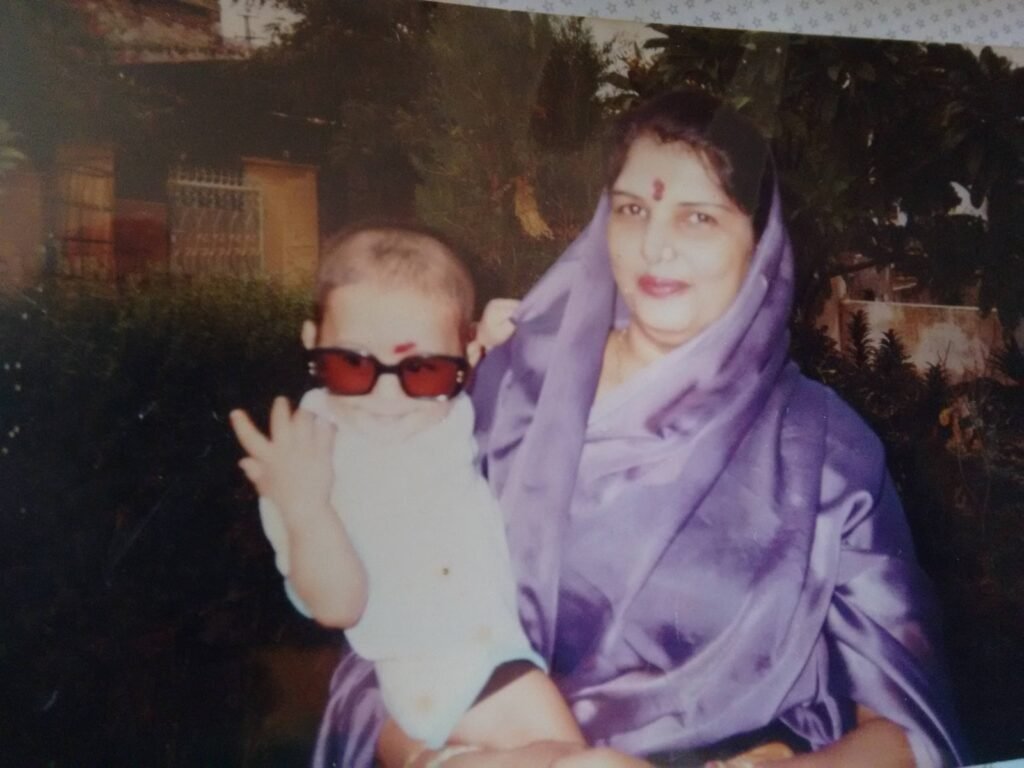
I would look at her old pictures, the ones when she got newly married. I would look into those eyes and try to understand what this young girl would have been thinking. She must be so excited about the new life that she’s going to start and looking forward to the dreams she wanted to come true.
And here I was, grieving for her own unlived life as well as mine. It made me even more sad, realizing I could not ever change someone’s destiny, especially of the person I loved so much.
I have hated myself for still living after her death, that my own heart was betraying me by still beating. I was supposed to die if she died, but I was alive, barely surviving.
The sense of identity loss, loss of purpose and understanding life after being a caretaker for so long, turned my emotions into a whirlwind. I couldn’t detach nor I wanted to detach myself from the role of a daughter. I felt this would be a betrayal to my mom if I thought of anything else, in fact I had spent years thinking about how to keep my mom well, that suddenly I realized I have no personal goal. I had no idea nor any wish to look forward to anything. To me life was just dragging, everything seemed pointless.
It finally started to hit me, I don’t know who I am, I don’t know how I would have been if things were normal. I had no idea who Neha could be, if not for this.
There were reasons I was trying to live, denial being one.
And denial is probably the state that is always there, maybe even after accepting too. I don’t know if, on a daily basis, grieving people can reminisce about their dead loved ones. They barely make it through birthdays or anniversaries, especially death anniversaries.
One of the things I hated was not being able to say goodbye at the hospital. Another was my own living. Then I was angry at her for not asking for my permission.
I would get vertigo whenever I looked at her picture. The Earth didn’t seem to rotate properly when I thought about her.
I spent unhealthy amounts of time at night looking at her last rites. Fortunately, or maybe only for me, there were videos of her cremation. And looking at them made it real. Contrary to popular belief, it healed me. And the biggest of all—the one thing that healed me was Time.
I don’t know if there’s anything apart from Time that can heal, but perhaps the other thing is Purpose. A reason to live. A reason to wake up every day. A reason to not think about your loved one and instead think about those who are left behind.
Death, even when it seems to be looming over our heads, when it does come, it comes sneakily. It takes away our senses, our authority over our own thoughts, our ability to understand what is happening to us and around us. Brain fog becomes a constant companion. Our body doesn’t seem to know what warmth means for a long while.
We unknowingly look for them everywhere, and we get scared when we do get a whiff of their existence in the corners of our daily life.
It takes a while to realize the tenses being used for them need to change, that the incidents we are sharing about them are the only memories we have. The accidental things we touch that belonged to them still carry a trace of them, a coldness that feels almost unbearable.
I only have compassion for the people who lost someone they were not prepared to lose. They may be living, but a piece of their heart has flown away and doesn’t belong to them anymore. They are looking for their loved one’s existence in another realm. They are looking for a sign from their loved one’s soul to tell them they are still loved.
They are still trying to understand whether they are still related, or if the alive one is the only one holding the ropes of this relationship.
Yet, they deny every day whether they are truly living or even allowed to live again like before. The void they carry in their hearts, in their life, engulfs them even when they seem happy, whispering to them to feel guilty for moving on.
Death not only takes a person—it makes the one left behind feel guilty for being alive.
Grief is not a journey for those who have never loved, but a road seemingly less traveled by those who choose to drag themselves through this road of loneliness, with no hope of ever learning to live without the person they loved so much.
Healing from grief feels like you’re sitting on this bed, bed being your emotional self. You can’t put your feet down, which is outside of your broken self, a logical self. The logical self is very painful to face, and it feels too hot to step on this floor. The logical self tells you to move on because what is gone is gone. And you, despite being scared of the hot burning floor, still want to go out of the room, to the outside world, to the normal life like before. You step down and then go out with all your strength but you still badly want to come back to the delusional grieving emotional self. You again go through that agonising pain of facing your logical self asking you to heal and live a normal life, and return to the bed, with no hope of any strength to leave this room ever again. And this cycle goes on for months, years and sometimes decades.
Grief doesn’t end; it shifts. And somewhere in that shift,it teaches, love never really leaves, it just changes form.
So I am trying, and would keep trying to keep her legacy alive in me. She would not like it after all this, if i hated living this much. I would try to understand why she made that sacrifice then, and why in all possible ways, whatever she did or God does, is an act of love. I may not completely see it today, but one day, I’ll be able to cherish her memories, and not be haunted by the emptiness she has left behind.
Now, I look for her in the quiet moments, in the warmth of the afternoon which is as peaceful as her, in the way I love my own child and when my daughter looks at me lovingly.
She left, but she didn’t leave me.